Inside most companies, AI is changing three functions fastest: operations (support, HR, procurement, software, security and everyday office work), marketing (content, ads, search and measurement) and sales (prospecting, selling conversations and the path to purchase). This guide describes 40 of those changes. Each one includes:
- What changes: the work AI now does or affects.
- Evidence: a study, a named company result or a ruling, with a link.
- Watch out for: the trade-off or failure mode.
How to read the evidence. Randomized field experiments, where some workers get AI and others do not, are the strongest evidence and several appear below. Company results are labeled as company figures. Where a careful study disagrees with a company claim, both are shown. Sources were checked in October 2026.
For how AI is changing whole industries, see 25 examples of how AI is transforming industries in 2026. For what these changes mean for jobs and careers, see 75 examples of how AI is changing the future of work.
Business operations
1. Copilots for customer support agents
What changes: AI suggests replies and relevant help articles to human agents during live chats.
Evidence: in a study of 5,179 customer support agents at a software company, access to an AI assistant increased issues resolved per hour by 14% on average and by 34% for novice and low-skilled workers, with little effect for the most experienced (Brynjolfsson, Li and Raymond, Quarterly Journal of Economics, 2025).
Watch out for: the gains came largely from spreading the know-how of top agents to newer ones. If AI replaces the junior roles where people learn, it may weaken the pipeline of future experts.
2. AI agents that handle support on their own
What changes: AI resolves whole conversations without a human, escalating only when it cannot.
Evidence: Klarna said in 2024 its assistant handled two-thirds of customer chats in its first month (Klarna, company figures), then began hiring human agents again in 2025 over quality concerns (Tech.co). Salesforce CEO Marc Benioff said support headcount fell from about 9,000 to about 5,000 as AI agents took on about half of conversations (Salesforce Ben).
Watch out for: measure resolution and repeat contacts, not just "containment." Customers who cannot reach a person leave.
3. HR service desks
What changes: a chatbot answers employee questions about pay, leave, benefits and policies, and completes simple transactions.
Evidence: IBM says its AskHR assistant contains 94% of common employee questions without a human taking over and handled more than 11.5 million interactions in 2024 (IBM, company figures).
Watch out for: "contained" means the bot handled it, not that the employee's problem was solved. Sensitive issues such as harassment or health need a direct route to people.
4. Procurement negotiation bots
What changes: an AI agent negotiates prices and payment terms with suppliers over chat.
Evidence: in a Walmart pilot with Pactum, a chatbot negotiated with suppliers of goods Walmart uses but does not sell. It closed deals with 64% of suppliers, against a target of 20%, with average savings of 1.5% and longer payment terms; three-quarters of suppliers said they preferred it to negotiating with a person (Harvard Business Review).
Watch out for: it works for many small, similar contracts. Strategic suppliers and complex deals still need human relationships.
5. Assistants inside email, documents and meetings
What changes: AI drafts emails, summarizes meetings and long documents, and searches files.
Evidence: in a UK government trial with about 20,000 civil servants, users reported saving an average of 26 minutes a day with Microsoft 365 Copilot (GOV.UK). A separate Department for Business and Trade evaluation found that most users saved time but found no evidence that productivity improved, and some tasks, such as scheduling, took longer (DBT evaluation).
Watch out for: self-reported minutes saved are not output. Check whether saved time turns into finished work.
6. Analysis and problem-solving for knowledge workers
What changes: consultants and analysts use AI for research, ideas, drafting and analysis.
Evidence: in a field experiment with 758 Boston Consulting Group consultants, those using GPT-4 on tasks inside the AI's capabilities completed 12.2% more tasks, 25.1% faster, with over 40% higher quality. On a task just outside those capabilities, they were 19 percentage points less likely to reach the correct answer than consultants without AI (Dell'Acqua et al., Harvard Business School, 2023).
Watch out for: the authors call this a "jagged frontier": AI is excellent at some tasks and confidently wrong at similar-looking ones. People need to learn where the edge is.
7. Business writing
What changes: AI produces first drafts of reports, press releases, emails and analyses.
Evidence: in a randomized experiment with 453 college-educated professionals, ChatGPT access cut time on writing tasks by 40% and raised rated quality by 18%, with the weakest writers gaining most (Noy and Zhang, Science, 2023).
Watch out for: the tasks were short and self-contained. Long documents that need accurate facts need more review.
8. Legacy code upgrades and migrations
What changes: AI agents upgrade old software to new language versions and frameworks, a tedious but essential maintenance task.
Evidence: Amazon says its Amazon Q Developer agent helped upgrade tens of thousands of production applications to Java 17, saving the equivalent of 4,500 developer-years of work and an estimated $260 million a year (AWS, company figures).
Watch out for: every change still needs testing and review. Upgrades are well defined, which is why they suit AI better than new features do.
9. Day-to-day coding
What changes: coding assistants complete code, write tests and explain unfamiliar codebases.
Evidence: in a 2023 controlled experiment, developers with GitHub Copilot completed a standalone programming task 55.8% faster (Peng et al., 2023). In a 2025 randomized trial with 16 experienced open-source developers working on their own large codebases, early-2025 AI tools made them 19% slower, though they believed they were faster (METR).
Watch out for: gains are largest on small, fresh tasks and smallest for experts in complex code they know well. Measure delivery time and defects, not perceived speed.
10. Security operations
What changes: AI summarizes security incidents, analyzes suspicious scripts and triages phishing reports for analysts.
Evidence: in Microsoft's randomized trials, experienced security analysts using Copilot for Security were 22% faster and 7% more accurate across tasks (Microsoft). A 2025 Microsoft trial of a phishing-triage agent reported analysts finding up to 6.5 times as many true positives per minute (Bono, 2025).
Watch out for: both studies come from the vendor. Attackers use the same tools, so speed gains may be needed just to keep pace.
11. Legal and contract work
What changes: lawyers use AI to summarize documents, compare contracts, draft clauses and research case law.
Evidence: law firms and in-house legal teams now commonly use legal AI tools. The risk is equally documented: researcher Damien Charlotin's AI Hallucination Cases database had logged well over 1,000 court decisions worldwide involving AI-fabricated citations by mid-2026.
Watch out for: every citation and quotation must be checked against the source. Courts have fined lawyers and referred them for discipline.
12. Multi-step agents for office work
What changes: agents attempt whole workflows: reading email, updating systems, filling forms and messaging colleagues.
Evidence: on TheAgentCompany, a Carnegie Mellon benchmark that simulates a small software firm, the best agents in mid-2025 completed only about 30% of tasks fully on their own (Xu et al., 2024). Gartner predicts that more than 40% of agentic AI projects will be canceled by the end of 2027 because of costs, unclear value or weak risk controls (Gartner).
Watch out for: "agent washing," where existing chatbots and automation are relabeled as agents. Start with narrow workflows with clear success criteria.
13. Back-office automation and the return-on-investment gap
What changes: companies move AI from pilots into finance, procurement and operations processes.
Evidence: MIT's NANDA initiative reported in 2025 that 95% of the organizations it studied saw no measurable profit-and-loss return from generative AI pilots, while noting that the biggest returns came from back-office automation rather than the sales and marketing tools that got most budgets (Fortune). The study's small sample and definitions drew criticism. McKinsey's 2025 survey similarly found only 39% of organizations reporting any earnings impact (McKinsey).
Watch out for: returns come from changing the workflow, not adding a tool to it.
14. Deepfake fraud and the controls it demands
What changes: criminals use AI-generated video and voice to impersonate executives and request payments.
Evidence: in early 2024, an Arup employee in Hong Kong transferred about $25 million after a video call in which the company's CFO and other colleagues were deepfakes (CNN).
Watch out for: a face and voice on a call are no longer proof of identity. Payment approvals need out-of-band verification and dual sign-off.
Marketing
15. Automated ad campaigns
What changes: ad platforms generate creative variations, choose audiences and set budgets with little human input.
Evidence: the Wall Street Journal reported in June 2025 that Meta aims to let advertisers fully create and target ads with AI by the end of 2026, starting from a product image and a budget (Campaign Asia).
Watch out for: less control over where ads appear and what they say. Brand-safety checks and creative guidelines need to be part of the setup.
16. AI-produced brand commercials
What changes: major brands produce television-quality ads largely with generative video.
Evidence: Coca-Cola's 2025 AI-made holiday ad, produced in about a month according to the company, drew heavy criticism online for visual glitches and for replacing human craft, though audience testing was less negative than social media (TechRadar).
Watch out for: for brands built on human warmth, the medium itself can become the story.
17. Cheaper creative production
What changes: image generation and AI copywriting reduce spending on photo shoots, agencies and translation.
Evidence: Klarna said in 2024 that generative AI cut its image production costs by about $6 million a year and its spending on external marketing agencies by 25%, contributing roughly $10 million in annualized marketing savings (Marketing Dive, company figures).
Watch out for: lower cost per asset can lead to more assets of lower quality. Measure campaign results, not production volume.
18. Product content at catalog scale
What changes: AI writes and fixes product titles, descriptions and attributes for millions of items.
Evidence: Walmart said in 2024 that it used large language models to create or improve more than 850 million data points in its product catalog, work it estimated would otherwise have needed nearly 100 times its headcount for that task (Retail Dive, company figures).
Watch out for: generated attributes can be wrong, such as sizes and materials, which leads to returns. Sample and audit.
19. Fewer clicks from search
What changes: AI summaries at the top of search results answer questions directly, so fewer people visit websites.
Evidence: a Pew Research Center analysis of 900 U.S. adults' browsing found that users clicked a traditional search result in 8% of visits when an AI summary appeared, compared with 15% when none appeared, and clicked a link inside the summary only 1% of the time (Pew Research Center). Google disputed the methodology.
Watch out for: traffic-based content strategies need a new plan: content worth citing, direct audiences such as newsletters, and measurement of conversions rather than raw visits.
20. AI assistants as a new discovery channel
What changes: shoppers ask chatbots for product recommendations and click through to retailers.
Evidence: Adobe Analytics reported that traffic to U.S. retail sites from generative AI tools rose 693% year over year in the 2025 holiday season, from a small base (Adobe).
Watch out for: you cannot buy placement in most chatbot answers. Accurate product data, reviews and being cited by trusted sources matter more.
21. Search penalties for mass-produced content
What changes: cheap AI content makes it easy to publish thousands of pages, and search engines have responded.
Evidence: in March 2024 Google introduced a "scaled content abuse" spam policy aimed at pages produced at scale mainly to rank, whether by people or automation, alongside a core update to reduce unhelpful content (Google Search Central).
Watch out for: using AI is not the problem; publishing pages with no original value is. Edit, add expertise and cut thin pages.
22. Open-source marketing mix modeling
What changes: statistical models estimate how much each channel contributes to sales, without relying on user-level tracking.
Evidence: Google made Meridian, its open-source Bayesian marketing mix model, available to all marketers in January 2025 (Search Engine Land); Meta's Robyn is a similar open-source tool.
Watch out for: a model from an ad platform is still a model. Validate it with experiments such as geographic holdout tests.
23. Synthetic customers for early market research
What changes: large language models answer survey questions as simulated customers, to test ideas cheaply.
Evidence: Harvard researchers found that GPT-generated willingness-to-pay estimates were sometimes comparable to human studies but often inaccurate, and in some cases had the wrong sign; fine-tuning on past survey data helped within a product category but not for new categories or segments (Brand, Israeli and Ngwe, revised 2026).
Watch out for: synthetic panels can screen ideas; they cannot replace research with real customers.
24. Review summaries
What changes: AI condenses hundreds of reviews into a short summary of what buyers like and dislike.
Evidence: Amazon began showing AI-generated review highlights on product pages in 2023 (Amazon).
Watch out for: summaries can amplify a few loud reviews or miss safety complaints. Keep the underlying reviews visible.
25. Bans on AI-generated fake reviews
What changes: regulators now treat fake reviews written by AI the same as any other fake review.
Evidence: the U.S. Federal Trade Commission finalized a rule in August 2024 banning fake reviews and testimonials, explicitly including AI-generated ones, with civil penalties for knowing violations (TechCrunch).
Watch out for: generating reviews, or paying for them, creates legal exposure as well as reputational risk.
26. Chatbots that speak for the brand
What changes: customer-facing chatbots answer policy questions on the company's behalf.
Evidence: in Moffatt v. Air Canada (2024), a Canadian tribunal held the airline liable after its website chatbot wrongly told a customer he could claim a bereavement discount retroactively, rejecting the argument that the chatbot was responsible for its own statements (Civil Resolution Tribunal).
Watch out for: whatever a chatbot promises, the company may have to honor. Ground answers in current policy documents and test them.
27. Disclosure rules for AI-generated content
What changes: laws are starting to require labels on synthetic media.
Evidence: Article 50 of the EU AI Act requires those who publish deepfakes to disclose that the content is artificially generated. These transparency duties apply from 2 August 2026; the "Digital Omnibus" amendment adopted in mid-2026 gave providers of systems already on the market until December 2026 for machine-readable marking (Addleshaw Goddard).
Watch out for: rules differ by country and platform. Build a policy for labeling AI content now rather than per campaign.
Sales
28. Copilots for sellers
What changes: AI prepares account briefs, drafts follow-ups, summarizes calls and updates the CRM.
Evidence: Microsoft reports that in one business group, sellers who were heavy users of Copilot generated 9.4% more revenue per seller and had 20% higher win rates (Microsoft Inside Track, company figures).
Watch out for: heavy users may already be the best sellers. Without a control group, the figure shows association, not cause.
29. Meeting notes that write themselves into the CRM
What changes: with client consent, AI records sales or advisory meetings and creates notes, CRM entries and draft follow-up emails.
Evidence: Morgan Stanley says its Debrief tool saves its financial advisors about 30 minutes per one-hour client meeting, with advisors reviewing outputs before they are used (OpenAI case study, company figures).
Watch out for: recordings and summaries become records. Errors and sensitive details need review before they are stored.
30. AI coaching for sales reps
What changes: AI analyzes call recordings and gives each rep feedback.
Evidence: a field experiment published in the Journal of Marketing found that AI coaching helped middle-ranked sales agents most; low performers struggled with the volume of feedback and top performers gained little, and a combination of AI and human coaches worked best (Luo et al., 2021).
Watch out for: more feedback is not better feedback. Prioritize one or two changes per rep.
31. AI sales calls and the disclosure effect
What changes: AI voice agents make outbound sales calls.
Evidence: in a field experiment with about 6,200 customers of a financial services company, undisclosed chatbots sold as well as proficient human agents, but disclosing the bot before the conversation reduced purchase rates by more than 79.7% (Luo et al., Marketing Science, 2019).
Watch out for: hiding that a caller is AI is increasingly illegal or against platform rules (see the next entry), and customers who find out may feel deceived.
32. Legal limits on AI voice calls
What changes: regulators apply robocall rules to AI-generated voices.
Evidence: in February 2024 the U.S. Federal Communications Commission ruled that AI-generated voices count as "artificial" voices under the Telephone Consumer Protection Act, so such calls need the recipient's prior express consent (FCC).
Watch out for: outbound AI calling without documented consent risks large statutory damages.
33. AI sales development agents, and inflated claims
What changes: startups sell "AI SDRs," agents that research prospects and send outreach automatically.
Evidence: TechCrunch reported in March 2025 that 11x, a prominent AI SDR startup, listed companies as customers that said they were not, including ZoomInfo and Airtable, and disputed its revenue figures (TechCrunch). Its founder stepped down as CEO later that year.
Watch out for: ask vendors for reference customers you can call and results from a controlled pilot.
34. High-volume outreach meets stricter inbox rules
What changes: AI makes it cheap to send thousands of personalized emails, and inbox providers have tightened the rules.
Evidence: Google and Yahoo began requiring bulk senders to authenticate their email, offer one-click unsubscribe and keep spam complaint rates low starting in February 2024 (Google).
Watch out for: volume without relevance damages the sender's domain reputation for every email the company sends.
35. Buyers research with AI before talking to sales
What changes: business buyers use chatbots to shortlist vendors, compare features and draft requirements.
Evidence: Forrester's buyer research reports that 94% of business buyers use generative AI somewhere in their buying process (Digital Commerce 360).
Watch out for: buyers arrive with conclusions shaped by what AI found about you. Make sure public documentation, pricing pages and reviews are accurate.
36. Instant quoting
What changes: AI reads quote requests from email and returns prices in seconds, any time of day.
Evidence: C.H. Robinson said in April 2025 that its AI agents had delivered well over 1 million freight price quotes and processed 1 million orders (C.H. Robinson, company figures).
Watch out for: fast quotes must still respect margins and capacity; automated pricing errors repeat at scale.
37. Shopping assistants as a sales channel
What changes: retailers' own conversational assistants answer product questions and guide purchases.
Evidence: Amazon said customers who use its Rufus assistant are 60% more likely to complete a purchase and that Rufus was on track for over $10 billion in incremental annualized sales, based on Amazon's own attribution (Fortune, company figures).
Watch out for: shoppers who use assistants may already be more likely to buy; attribution windows shape the headline number.
38. Checkout inside chatbots, and why it stalled
What changes: AI companies tried to let shoppers complete purchases inside a chat.
Evidence: OpenAI launched Instant Checkout in ChatGPT in September 2025 and scaled it back in March 2026 in favor of sending shoppers to merchants' own apps and sites, after limited merchant uptake (Forrester).
Watch out for: merchants want to own the customer relationship, data and checkout. Expect AI to drive discovery more than transactions for now.
39. Pricing algorithms and antitrust risk
What changes: algorithms recommend prices using data from many competitors.
Evidence: in August 2024 the U.S. Department of Justice and several states sued RealPage, alleging its rent-pricing software let landlords share nonpublic data and align rents (U.S. Department of Justice).
Watch out for: an algorithm that uses competitors' confidential data to set prices can raise the same legal issues as an agreement between competitors.
40. Quality control for AI-assisted work
What changes: as AI output spreads across sales, marketing and operations, reviewing it becomes part of everyone's job.
Evidence: a 2025 survey by BetterUp Labs and the Stanford Social Media Lab found that 40% of U.S. desk workers had received "workslop" in the past month: AI-generated work that looks polished but lacks the substance to move a task forward, costing time to fix (Harvard Business Review).
Watch out for: the sender saves time and the receiver loses it. Set norms: AI output is a draft that the sender checks and owns.
Patterns across the 40 changes
- AI helps novices most. Support agents (entry 1), writers (entry 7) and sales reps (entry 30) with less experience gained most, which narrows skill gaps but may change how people learn the job.
- The frontier is jagged. The same tool that speeds one task slows another (entries 6 and 9). Teams need to learn where it fails.
- Full automation invites reversals. Support (entry 2) and agentic checkout (entry 38) show that removing people entirely can backfire.
- Liability stays with the company. Chatbot promises (entry 26), fake reviews (entry 25), AI voice calls (entry 32) and pricing data (entry 39) are all governed by existing law.
- Returns depend on workflow change. Surveys (entry 13) find usage everywhere and profit in few places.
A checklist for adopting AI in a business function
- Pick one high-volume task with a clear definition of done.
- Measure the baseline first: time, cost, error rate and customer outcomes.
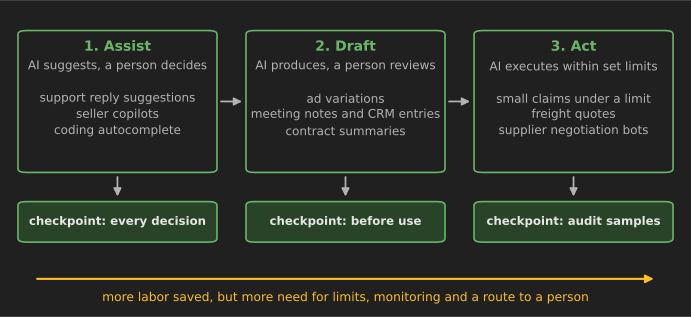
- Choose the autonomy level (assist, draft or act) and the human checkpoint for each.
- Run a controlled pilot, with a group that does not use the tool, for long enough to see quality problems.
- Track the receiver's time, not just the sender's, so "workslop" is counted.
- Keep a route to a human for customers and employees.
- Review legal exposure for customer-facing outputs: disclosures, consent, reviews and pricing.
- Decide in advance what result would make you stop.
Where to go next
- See industry-specific examples in 50 AI use cases in manufacturing, retail and logistics and 30 AI applications in healthcare, finance and education.
- Read what the evidence says about jobs and skills in 75 examples of how AI is changing the future of work.
- For the predictive models behind lead scoring, churn and forecasting, read 100 machine learning applications across industries and 101 Python machine learning examples.
References
Sources are linked in each entry. Key studies:
- Brynjolfsson, E., Li, D., & Raymond, L. (2025). "Generative AI at Work." The Quarterly Journal of Economics, 140(2). doi.org/10.1093/qje/qjae044
- Dell'Acqua, F., et al. (2023). "Navigating the Jagged Technological Frontier: Field Experimental Evidence of the Effects of AI on Knowledge Worker Productivity and Quality." Harvard Business School Working Paper 24-013. hbs.edu
- Noy, S., & Zhang, W. (2023). "Experimental evidence on the productivity effects of generative artificial intelligence." Science, 381(6654). doi.org/10.1126/science.adh2586
- Peng, S., Kalliamvakou, E., Cihon, P., & Demirer, M. (2023). "The Impact of AI on Developer Productivity: Evidence from GitHub Copilot." arxiv.org/abs/2302.06590
- Xu, F. F., et al. (2024). "TheAgentCompany: Benchmarking LLM Agents on Consequential Real World Tasks." arxiv.org/abs/2412.14161
- Luo, X., Tong, S., Fang, Z., & Qu, Z. (2019). "Frontiers: Machines vs. Humans: The Impact of Artificial Intelligence Chatbot Disclosure on Customer Purchases." Marketing Science. doi.org/10.1287/mksc.2019.1192
- Luo, X., Qin, M. S., Fang, Z., & Qu, Z. (2021). "Artificial Intelligence Coaches for Sales Agents: Caveats and Solutions." Journal of Marketing, 85(2). doi.org/10.1177/0022242920956676
- McKinsey & Company (November 2025). The state of AI in 2025: Agents, innovation, and transformation. mckinsey.com