AI is changing work in three ways at once: it changes the tasks inside jobs, it changes how many people employers hire for some roles, and it changes the rules and skills around work. The evidence so far, as of October 2026, points to a clear picture. AI use at work is common but not yet intensive; controlled studies show real productivity gains on specific tasks, and some slowdowns; broad unemployment has not appeared; and the clearest negative signal is weaker hiring of young workers in the most AI-exposed jobs.
This guide gives 75 examples in eight groups. Each one is a specific study, survey, company action, law or deployment, linked to its source, with a short note on what it means.
How to read the evidence. Randomized trials and large administrative data sets (payroll or tax records) are the strongest evidence. Surveys tell you what people report, not what happened. Executive statements and company figures tell you what organizations claim or plan. Forecasts are forecasts. Each example says which kind it is. Sources were checked in October 2026.
For how AI is changing specific industries, see 25 examples of how AI is transforming industries in 2026, and for specific business functions, see 40 ways AI is changing business operations, marketing and sales.
How AI shows up in daily work
1. Most workers use AI occasionally, few use it daily
A Gallup survey of more than 22,000 U.S. workers, reported in January 2026, found that about 12% use AI daily in their job, about a quarter use it a few times a week or more, and close to half use it at least a few times a year, up from 21% in 2023 (AP via News4JAX). Survey.
What it means: headlines about AI "everywhere" describe access more than daily dependence.
2. Technology workers are far ahead
In the same Gallup data, about six in ten technology workers used AI frequently and about three in ten daily, with signs that adoption in tech was leveling off after a sharp rise (AP via News4JAX). Survey.
What it means: software work is the leading indicator for what other desk jobs may see.
3. Many workers bring their own AI tools
Microsoft and LinkedIn's 2024 Work Trend Index, a survey of 31,000 people in 31 countries, found that 78% of AI users brought their own AI tools to work rather than waiting for employer-provided ones (Microsoft WorkLab). Survey.
What it means: unofficial use creates data-security risks and makes productivity hard to measure. Clear policies and approved tools reduce both problems.
4. People increasingly delegate whole tasks to AI
Anthropic's Economic Index found that "directive" conversations, where users hand Claude a complete task rather than iterating with it, rose from 27% of sampled conversations in late 2024 to 39% in 2025, and that business use through its API was dominated by automation patterns (Anthropic Economic Index report). Usage data from one AI provider.
What it means: the move from "AI as assistant" to "AI as delegate" is visible in usage, which raises the stakes for review.
5. Managers expect to supervise AI agents
Microsoft's 2025 Work Trend Index describes "Frontier Firms" built on human-agent teams and reports that leaders expect their teams to be training and managing AI agents within five years; 67% of leaders said they were familiar with agents compared with 40% of employees (Microsoft WorkLab). Survey and vendor framing.
What it means: delegating to and checking agents is becoming a management skill, but the vendor selling agents is also the one defining the trend.
6. Office workers save minutes on email and meetings
In a UK government trial with about 20,000 civil servants, users of Microsoft 365 Copilot reported saving 26 minutes a day on average, mostly on drafting, summarizing and searching (GOV.UK). Self-reported trial.
What it means: small time savings are common; whether they turn into more or better work is a separate question (example 19).
7. Engineers write less code by hand
Alphabet CEO Sundar Pichai said in 2025 that well over 30% of new code at Google was generated with AI and then reviewed and accepted by engineers, up from about a quarter in late 2024 (Fortune, 2024). Company statement.
What it means: engineering time shifts toward specifying, reviewing and testing code.
8. Developers use AI more and trust it less
In the 2025 Stack Overflow Developer Survey of about 49,000 developers, 84% used or planned to use AI tools, but 46% distrusted their accuracy against 33% who trusted it, and 66% said their biggest frustration was answers that were "almost right, but not quite" (Stack Overflow). Survey.
What it means: verification is now a core developer skill.
9. Doctors spend less time typing notes
At Kaiser Permanente, about 7,260 physicians used ambient AI scribes across roughly 2.5 million patient visits, saving an estimated 15,791 hours of documentation (AMA). Health system analysis.
What it means: in some jobs, AI removes the part people like least, which can improve job quality as well as speed.
10. Teachers reclaim planning time
U.S. teachers who used AI at least weekly reported saving 5.9 hours a week in a 2025 Gallup and Walton Family Foundation survey, but only 32% used it weekly (Walton Family Foundation). Survey.
What it means: large gains for some users coexist with low adoption overall.
11. Professionals are sanctioned for unchecked AI output
Damien Charlotin's database of court decisions involving AI-fabricated legal citations had logged well over 1,000 cases worldwide by mid-2026 (AI Hallucination Cases database). Case database.
What it means: professional accountability does not transfer to the tool; checking AI work is part of the job.
What controlled studies show about productivity
12. Customer support agents resolve more issues, especially novices
In a study of 5,179 support agents, an AI assistant raised issues resolved per hour by 14% on average and by 34% for novice and low-skilled agents, with little gain for top performers (Brynjolfsson, Li and Raymond, QJE, 2025). Staggered rollout study.
What it means: AI spreads the know-how of the best workers to newer ones, narrowing skill gaps.
13. Writing tasks get faster and better
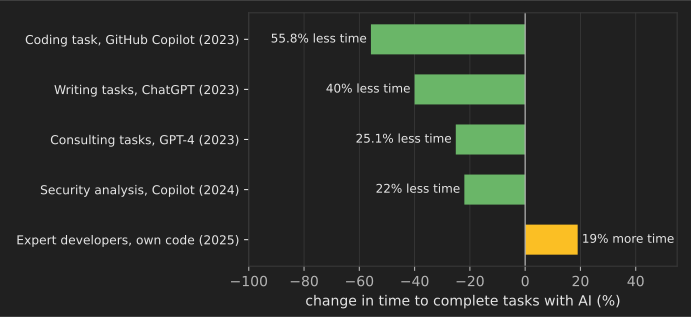
In a randomized experiment with 453 college-educated professionals, ChatGPT cut time on writing tasks by 40% and raised rated quality by 18% (Noy and Zhang, Science, 2023). Randomized experiment.
What it means: first drafts are now cheap; judgment about what to say is not.
14. Consultants gain inside the frontier and lose outside it
Among 758 BCG consultants, GPT-4 users completed 12.2% more tasks 25.1% faster with over 40% higher quality on tasks within AI's capabilities, but were 19 percentage points less likely to get a correct answer on a task just outside them (Dell'Acqua et al., 2023). Randomized experiment.
What it means: knowing where AI fails is now a professional skill.
15. Coding a contained task is much faster
Developers given GitHub Copilot completed a standalone programming task 55.8% faster than a control group (Peng et al., 2023). Randomized experiment.
What it means: the biggest gains come on well-defined, self-contained tasks.
16. Experts on complex familiar code can be slower
In a 2025 randomized trial, 16 experienced open-source developers took 19% longer on tasks in their own large repositories when allowed early-2025 AI tools, while believing they had been about 20% faster (METR). Randomized trial, small sample.
What it means: perceived productivity and measured productivity can diverge.
17. Security analysts work faster
In Microsoft's randomized trials, experienced security analysts with Copilot for Security were 22% faster and 7% more accurate across tasks (Microsoft). Vendor-run randomized trial.
What it means: gains in specialist jobs are real but should be confirmed by independent studies.
18. Human tutors teach better with real-time AI suggestions
In a randomized trial with about 900 tutors, students whose tutors used Stanford's Tutor CoPilot were 4 percentage points more likely to master topics, and 9 points more likely when their tutor was lower-rated (Stanford NSSA). Randomized trial.
What it means: AI can upgrade the skills of a human workforce rather than replace it.
19. Time saved is not always productivity gained
A UK Department for Business and Trade evaluation of Microsoft 365 Copilot found that most users saved time but found no evidence of improved productivity, and some tasks such as scheduling took longer (DBT evaluation). Government evaluation without a control group.
What it means: measure finished output and quality, not minutes saved.
20. Economy-wide effects on pay and hours are small so far
Linking surveys of about 25,000 Danish workers in 11 exposed occupations to administrative records, economists found time savings of around 3% and precisely estimated zero effects on earnings and recorded hours two years after chatbots arrived (Humlum and Vestergaard, NBER, 2025). Administrative data.
What it means: task-level gains have not yet shown up in pay or working time for most workers.
21. AI-made "workslop" costs colleagues time
A 2025 survey by BetterUp Labs and the Stanford Social Media Lab found that 40% of U.S. desk workers had received AI-generated work in the past month that looked polished but lacked substance, and that each instance took nearly two hours to deal with (Harvard Business Review). Survey.
What it means: the sender's time saving can become the receiver's time cost.
22. Sellers using AI heavily sell more
Microsoft reports that in one business group, sellers who were heavy users of Copilot generated 9.4% more revenue per seller and had 20% higher win rates (Microsoft Inside Track). Company figures, no control group.
What it means: promising, but heavy users may already be top performers.
23. AI-exposed industries show faster productivity growth
PwC's 2026 Global AI Jobs Barometer, based on more than a billion job ads, found productivity in the most AI-exposed sectors grew 34% from 2018 to 2025, against 24% in the least exposed (PwC). Consultancy analysis.
What it means: a correlation across industries, consistent with AI helping, but not proof that AI caused the difference.
Jobs and the labor market
24. Young workers in AI-exposed jobs are being hired less
Using ADP payroll data, Stanford economists found that employment of 22- to 25-year-olds in the most AI-exposed occupations, such as software developers and customer service agents, fell by about 13% relative to less-exposed occupations after late 2022, while older workers in the same jobs were unaffected (Stanford Digital Economy Lab). The decline came mainly through fewer hires rather than layoffs, and later updates in 2026 reported a wider gap. Administrative payroll data; the authors call it descriptive, not causal.
What it means: the first visible labor effect is on the bottom rung of the career ladder.
25. Young software developers are hit hardest
Stanford's 2026 AI Index reports that employment of U.S. software developers aged 22 to 25 fell nearly 20% from 2024, while large-scale job losses had not appeared in overall employment data (AI Index 2026, Economy). Data compilation.
What it means: entry-level coding jobs, often automated first, are where the effect is concentrated.
26. No economy-wide disruption yet
The Yale Budget Lab found in October 2025 that, about 33 months after ChatGPT's release, the mix of U.S. occupations was changing only slightly faster than in past periods, with a trend that predated generative AI and no link between AI exposure and changes in employment (Yale Budget Lab). Official statistics analysis.
What it means: concentrated effects and broad stability can both be true at the same time.
27. Employers forecast churn, not just loss
The World Economic Forum's Future of Jobs Report 2025, a survey of over 1,000 employers covering 14 million workers, projected 170 million jobs created and 92 million displaced by 2030, a net gain of 78 million, with 41% of employers planning to reduce staff where AI can automate tasks (World Economic Forum). Employer survey and forecast.
What it means: people in shrinking roles are not automatically the ones who get the new jobs.
28. One in four jobs worldwide is exposed
The International Labour Organization's refined index (May 2025) estimates that about a quarter of global employment is in occupations potentially exposed to generative AI: 34% in high-income countries against 11% in low-income ones. Women's jobs are more often in the highest-exposure category (ILO). Exposure index.
What it means: "exposed" means some tasks could be done by AI, which usually means transformation rather than elimination.
29. Advanced economies face more exposure, and more upside
The International Monetary Fund estimated in 2024 that about 40% of global employment, and around 60% in advanced economies, is exposed to AI, with roughly half of exposed jobs likely to benefit from AI and half at risk of reduced demand (IMF). Exposure analysis.
What it means: the same exposure can raise or lower demand depending on whether AI complements or substitutes for the work.
30. Freelance writers lost work after ChatGPT
A study of 92,547 freelance writers on Upwork found that after ChatGPT's release, writing-related freelancers saw about 2% fewer monthly jobs and 5.2% lower monthly earnings, and higher-earning freelancers were not protected (Hui, Reshef and Zhou, Organization Science). Platform data.
What it means: freelance markets, with no contracts or hiring processes in the way, show effects first.
31. Support headcount shrinks through attrition
Salesforce CEO Marc Benioff said in 2025 that the company's support headcount fell from about 9,000 to about 5,000 as AI agents handled about half of customer conversations; Salesforce said it stopped backfilling roles and redeployed people (Salesforce Ben). Executive statement.
What it means: many AI workforce changes happen as "not replacing" rather than layoffs, which makes them hard to see in layoff data.
32. Some companies reverse course
Klarna, which said its AI assistant did the work of about 700 customer service agents in 2024, began hiring human agents again in 2025 after its CEO said the cost-cutting had gone too far on quality (Tech.co). Company statements.
What it means: automation that saves cost but loses customers does not last.
33. Large corporate layoffs are linked to AI, and disputed
Amazon cut about 14,000 corporate roles in October 2025 and announced about 16,000 more in early 2026; an internal letter tied the changes to AI, while CEO Andy Jassy later said they were driven mainly by bureaucracy and culture rather than AI or finances (TechCentral.ie). Company statements.
What it means: "AI" is sometimes the explanation offered for cuts with several causes. Look at which roles are affected.
34. Automation plans can avoid future hiring
Internal Amazon documents reported by the New York Times in October 2025 projected that automation could let the company avoid hiring more than 600,000 U.S. workers by 2033; Amazon said the documents reflected one team's view (Computerworld). Reported internal plans.
What it means: the effect of automation often shows up as jobs that are never created.
35. Employers expect modest headcount change
In McKinsey's 2025 global survey, 32% of respondents expected AI to reduce their organization's headcount in the next year, 43% expected no change and 13% expected increases (McKinsey). Survey.
What it means: most organizations expect gradual adjustment, not sudden replacement.
36. AI leaders warn of steep entry-level losses
Anthropic CEO Dario Amodei told Axios in May 2025 that AI could eliminate half of entry-level white-collar jobs and push U.S. unemployment to 10 to 20% within one to five years (Axios). Many economists expect slower change. Prediction.
What it means: treat it as a scenario to prepare for, not a forecast with evidence behind it yet.
37. Experts and the public disagree sharply
The 2026 AI Index reports that 73% of AI experts expect AI to have a positive effect on how people do their jobs, compared with 23% of the U.S. public (AI Index 2026). Surveys.
What it means: trust is a constraint on adoption; workers' concerns need answers, not dismissal.
38. Workers are more worried than hopeful
A Pew Research Center survey of 5,273 employed U.S. adults, published in February 2025, found that 52% were worried about AI's future impact on the workplace, 36% hopeful, and only 16% said at least some of their work was done with AI (Pew Research Center). Survey.
What it means: anxiety runs ahead of actual use.
Hiring, careers and HR
39. "Prove AI can't do it" before hiring
Shopify CEO Tobi Lütke told staff in April 2025 that using AI was a baseline expectation, that AI use would be part of performance reviews, and that teams must show why AI cannot do a job before asking for more headcount (eMarketer). Company policy.
What it means: AI is becoming part of how headcount decisions are justified.
40. "AI-first" companies cut contractor work
Duolingo's CEO declared the company "AI-first" in April 2025, saying it would gradually stop using contractors for work AI can handle and would consider AI use in hiring and reviews; days later it launched 148 courses built with generative AI (TechCrunch). Company policy.
What it means: contractors and freelancers are often first in line when AI takes over content work.
41. AI screening tools face discrimination lawsuits
In Mobley v. Workday, a U.S. federal judge in May 2025 allowed a nationwide collective action to proceed on claims that Workday's AI screening tools discriminated against applicants aged 40 and over (Holland & Knight). Litigation in progress.
What it means: both employers and vendors may be responsible for biased automated decisions.
42. Bias audit laws exist but are weakly enforced
New York City's Local Law 144 requires bias audits and notices for automated hiring tools. A December 2025 audit by the New York State Comptroller found the city's enforcement ineffective, citing weak complaint handling and inaccurate compliance reviews (Office of the New York State Comptroller). Government audit.
What it means: compliance on paper is not the same as fair hiring in practice.
43. A famous hiring model learned bias
Amazon scrapped an experimental résumé-screening model around 2018 after finding it penalized résumés that mentioned women's organizations, because it learned from a decade of mostly male hires (Reuters). Investigative reporting.
What it means: models trained on past decisions reproduce past patterns unless that is tested and corrected.
44. Fake candidates use AI to get hired
Gartner predicts that by 2028 one in four job candidate profiles worldwide will be fake, and in a 2025 Gartner survey 6% of job seekers admitted to interview fraud (Staffing Industry Analysts). Forecast and survey.
What it means: remote hiring needs identity verification that deepfakes cannot easily fool.
45. State-backed schemes place fake remote workers
In June 2025 the U.S. Justice Department announced actions against North Korean remote IT worker schemes, including searches of 29 suspected "laptop farms" in 16 states, saying the workers had obtained jobs at more than 100 U.S. companies (U.S. Department of Justice). Law enforcement action.
What it means: hiring fraud is also a security and sanctions risk.
46. HR questions go to chatbots first
IBM says its AskHR assistant handles 94% of common employee HR questions without a human taking over and handled more than 11.5 million interactions in 2024 (IBM). Company figures.
What it means: HR roles shift from answering routine questions to handling sensitive and complex cases.
47. Call-center staff can be redeployed
IKEA's operator Ingka said its AI bot handled 47% of customer queries in its first two years, and that it had retrained 8,500 call-center workers as remote interior design advisers, a new revenue stream (Retail Gazette). Company figures.
What it means: redeployment works when the company has valuable work for people to move into.
New roles and skills
48. AI engineer is the fastest-growing job title
LinkedIn's 2025 Jobs on the Rise report for the U.S. ranked artificial intelligence engineer first and AI consultant second, based on hiring trends from 2022 to 2024 (HR Grapevine). Platform data.
What it means: demand for building and deploying AI is growing fastest, but it is a small share of total jobs.
49. AI skills earn a wage premium
PwC's 2026 Global AI Jobs Barometer found that job ads requiring AI skills offered an average wage premium of 62%, up from 57% a year earlier, and that jobs requiring specific AI skills grew 69% against 9% for the market (PwC). Job-ad analysis.
What it means: premiums in job ads describe what employers offer, not what all workers with AI skills earn.
50. Skills required in exposed jobs change faster
PwC's analysis also found that the skills employers seek in the most AI-exposed occupations are changing more than twice as fast as in the least exposed, and the WEF expects nearly 40% of core job skills to change by 2030 (World Economic Forum). Job-ad analysis and employer survey.
What it means: continuous learning becomes part of the job, not something done once before it.
51. Two diverging paths for jobs
PwC's 2026 barometer describes "professionalised" roles, where AI amplifies expert judgment, growing about twice as fast and with faster salary gains than "democratised" roles, where AI lowers the barrier to entry and adds competition (PwC). Job-ad analysis.
What it means: deep expertise plus AI is a stronger position than routine skills plus AI.
52. Gig workers earn money training AI
Uber began piloting "digital tasks" in 2025 that let U.S. drivers and couriers earn small payments for recording speech, uploading images and other AI data work in the Uber app, after a test in India (SlashGear). Company program.
What it means: AI creates a large, low-paid market for data work, often done by the workers whose jobs the AI may later affect.
53. AI companies launch certifications and job platforms
OpenAI announced in September 2025 a jobs platform and certification program, committing to certify 10 million Americans in AI skills by 2030 with partners including Walmart (Built In). Company commitment.
What it means: certifications are useful only if employers recognize them; watch for evidence that they lead to jobs.
54. Teachers' unions build AI training with AI companies
The American Federation of Teachers launched a $23 million National Academy for AI Instruction in July 2025 with Microsoft, OpenAI and Anthropic, aiming to train about 400,000 educators (TechRepublic). Program announcement.
What it means: training is shifting to unions and employers, though funders are also vendors seeking adoption.
55. Labor unions and tech companies sign AI partnerships
The AFL-CIO and Microsoft announced a partnership in December 2023 to share information on AI trends with labor leaders and workers, include worker perspectives in AI development, and support skills training (Microsoft). Partnership agreement.
What it means: worker voice in AI design is starting to be formalized.
56. Relying on AI can erode skills
In a study across four Polish endoscopy centers, experienced endoscopists' adenoma detection rate in colonoscopies performed without AI fell from 28.4% before AI tools were introduced to 22.4% after (ASCO Post). Observational study.
What it means: organizations need to protect the skills people need when the AI is unavailable or wrong.
57. Students who lean on AI learn less
High school students given unrestricted GPT-4 for practice scored 17% lower on later exams without AI than students who never had it, while a tutor version that gave hints removed the harm (Bastani et al., PNAS, 2025). Field experiment.
What it means: for the future workforce, how AI is used while learning matters more than whether it is used.
58. Novices gain most, which reshapes career ladders
In both the customer support study (example 12) and the writing experiment (example 13), the least experienced or lowest-rated workers gained most from AI. Pattern across two large studies.
What it means: AI can speed up learning on the job, but only if junior roles still exist to learn in (example 24).
Management, monitoring and wellbeing
59. Emotion recognition at work is banned in the EU
The EU AI Act prohibits AI systems that infer emotions of people in the workplace, except for medical or safety reasons, from February 2025 (EU AI Act, Article 5). Law in force.
What it means: some forms of AI monitoring are now illegal, not just controversial.
60. Employers must build AI literacy
Article 4 of the EU AI Act, in force since February 2025, requires providers and deployers of AI systems to take measures to ensure sufficient AI literacy among staff who use them (EU AI Act). Law in force.
What it means: training is a legal obligation for EU employers deploying AI, not a perk.
61. Rules for algorithmic management of platform workers
The EU Platform Work Directive, adopted in 2024 with a transposition deadline in late 2026, requires human oversight of automated monitoring and decision systems and gives platform workers the right to an explanation of significant automated decisions (Directive (EU) 2024/2831). Law being implemented.
What it means: "the algorithm decided" is no longer an acceptable answer for gig workers in the EU.
62. High-risk AI rules for hiring are delayed
EU AI Act obligations for high-risk systems used in recruitment and worker management were originally due in August 2026. The "Digital Omnibus" amendment, formally adopted in mid-2026, moved them to 2 December 2027 (Addleshaw Goddard). Law in force.
What it means: employers gain time, but the requirements for risk management, documentation and human oversight are coming.
63. Leaders and employees see AI differently
Microsoft's 2025 Work Trend Index found that 79% of leaders believed AI would accelerate their careers compared with 67% of employees (Microsoft WorkLab). Survey.
What it means: rollouts designed by optimistic leaders need input from the people expected to use the tools.
64. AI can reduce burnout in some jobs
In UCLA's randomized trial of ambient AI scribes with 238 physicians, both scribe products modestly improved measures of burnout and workload (UCLA Health). Randomized trial.
What it means: removing low-value tasks can improve wellbeing, not only output.
65. Studies find AI drafts reduce burden without saving time
At Stanford Health Care, AI-drafted replies to patient messages reduced clinicians' reported task load and exhaustion but did not reduce time spent replying (Garcia et al., JAMA Network Open, 2024). Prospective study.
What it means: "easier" and "faster" are different outcomes; both matter.
Rights, contracts and bargaining
66. Screenwriters won limits on AI
The Writers Guild of America's 2023 contract says AI-generated material is not literary material, that companies cannot require writers to use AI, and that companies must disclose AI-generated material given to writers; the 2026 contract kept these terms (Writers Guild of America). Collective agreement.
What it means: collective bargaining can set enforceable rules on AI faster than legislation.
67. Video game performers secured consent rules
SAG-AFTRA members ratified a video game contract in July 2025, ending an 11-month strike, with consent and disclosure requirements for AI digital replicas of performers' voices and likenesses (AWN). Collective agreement.
What it means: consent and pay for digital replicas are becoming standard demands in creative work.
68. Robocall law covers AI voices
The U.S. Federal Communications Commission ruled in February 2024 that AI-generated voices count as "artificial" under the Telephone Consumer Protection Act, so AI calls need prior consent (FCC). Regulatory ruling.
What it means: replacing call-center work with AI voices is subject to existing consumer protection law.
69. AI therapy without a clinician is banned in Illinois
Illinois enacted a law in August 2025 barring AI from providing therapy or making therapeutic decisions without a licensed professional, while allowing administrative uses (Healthcare Finance News). State law.
What it means: some professions are drawing legal lines around which tasks AI may do.
70. Chatbot statements bind employers
A Canadian tribunal held Air Canada liable in 2024 for a discount its website chatbot wrongly promised, rejecting the argument that the chatbot was responsible for its own words (Civil Resolution Tribunal). Tribunal decision.
What it means: when AI does customer-facing work, the employer remains responsible.
Physical work and robots
71. Humanoid robots complete a long factory job
Figure AI says its humanoid robots worked 10-hour shifts at BMW's Spartanburg plant for 11 months, loading more than 90,000 sheet-metal parts (Figure AI). Company figures.
What it means: humanoids are reaching real tasks, but at small scale and unproven cost.
72. Warehouse robots take over strenuous tasks
DHL agreed in 2025 to deploy more than 1,000 additional Boston Dynamics Stretch robots, which unload trucks and containers at up to 700 cases an hour, work that is physically demanding in hot or cold trailers (Supply Chain Digital). Company agreement.
What it means: the first jobs robots take are often the most physically punishing ones.
73. Warehouse fleets pass a million robots
Amazon deployed its millionth robot in July 2025 and introduced a generative AI model to coordinate its fleet (Amazon). Company figures.
What it means: warehouse work is shifting toward maintaining, supervising and working alongside robots.
74. Robotaxis scale up in U.S. cities
Waymo reached about 500,000 paid rides a week across 10 U.S. cities in spring 2026, double its level a year earlier (Electrek). Company figures.
What it means: professional driving, one of the largest occupations, faces its first real automation, starting city by city.
75. Driverless trucks carry commercial freight
Aurora began commercial driverless trucking between Dallas and Houston in May 2025 (TechCrunch). Company launch.
What it means: long-haul driving may change hub by hub, with human drivers still needed for local routes for years.
What the 75 examples add up to
- Tasks change before jobs disappear. Most evidence shows AI taking over parts of jobs (examples 6 to 18), with modest effects on total employment so far (examples 20 and 26).
- The entry level is the pressure point. The clearest labor-market effect is on young workers in exposed occupations (examples 24 and 25), while AI helps novices most on the job (example 58). Companies that stop hiring juniors may lose their future experts.
- Measured gains are smaller and more varied than perceived ones. Self-reports and company figures run ahead of controlled studies (examples 16, 19 and 21).
- Skills now need active protection. Over-reliance can erode skills in medicine (example 56) and learning (example 57).
- Rules are arriving through many channels: EU law (examples 59 to 62), U.S. lawsuits and audits (examples 41 and 42), union contracts (examples 66 and 67) and existing consumer law (examples 68 and 70).
What workers and employers can do now
For workers:
- Learn where AI fails in your work, not just where it helps. That judgment is what employers pay for (example 14).
- Keep doing the core skills yourself often enough that you could do them without AI (example 56).
- Check and own everything AI produces before you send it (examples 11 and 21).
- Build depth in a domain. AI amplifies expertise more than it replaces it (example 51).
- Document your AI-assisted results in measurable terms for reviews and job applications.
For employers:
- Measure output and quality, not self-reported minutes saved (example 19).
- Keep hiring and training junior staff, redesigning entry-level roles around supervised AI use rather than removing them (example 24).
- Provide approved tools and clear rules so people do not bring their own (example 3).
- Audit AI used in hiring and management for bias and legal compliance (examples 41 to 43).
- Plan redeployment before automating roles (example 47).
Frequently asked questions
Will AI take my job?
For most people, the evidence through 2026 shows AI changing tasks within jobs rather than eliminating them. The risk is highest for entry-level roles in exposed occupations such as customer support and junior software development, and for freelance writing and similar work bought task by task.
Which jobs are most exposed to AI?
Clerical, customer service, writing, translation, programming and some financial and legal analysis tasks are most exposed according to the ILO and IMF indexes. Exposure means AI can perform some tasks, which can raise or lower demand for the job.
Which skills matter most?
The studies here point to judgment about when AI is wrong, deep domain expertise, the ability to specify and review work, and the human skills of explaining, persuading and caring for people.
Where to go next
- See industry examples in 25 examples of how AI is transforming industries in 2026 and 30 AI applications in healthcare, finance and education.
- See the functions changing fastest in 40 ways AI is changing business operations, marketing and sales and 50 AI use cases in manufacturing, retail and logistics.
- Build practical AI skills with 101 machine learning projects and 100 machine learning algorithms explained.
References
Sources are linked in each example. Key studies and reports:
- Brynjolfsson, E., Li, D., & Raymond, L. (2025). "Generative AI at Work." The Quarterly Journal of Economics, 140(2). doi.org/10.1093/qje/qjae044
- Noy, S., & Zhang, W. (2023). "Experimental evidence on the productivity effects of generative artificial intelligence." Science, 381(6654). doi.org/10.1126/science.adh2586
- Dell'Acqua, F., et al. (2023). "Navigating the Jagged Technological Frontier." Harvard Business School Working Paper 24-013. hbs.edu
- Peng, S., et al. (2023). "The Impact of AI on Developer Productivity: Evidence from GitHub Copilot." arxiv.org/abs/2302.06590
- Becker, J., Rush, N., et al. (2025). "Measuring the Impact of Early-2025 AI on Experienced Open-Source Developer Productivity." METR. metr.org
- Brynjolfsson, E., Chandar, B., & Chen, R. (2025). "Canaries in the Coal Mine? Six Facts about the Recent Employment Effects of Artificial Intelligence." Stanford Digital Economy Lab. digitaleconomy.stanford.edu
- Humlum, A., & Vestergaard, E. (2025). "Large Language Models, Small Labor Market Effects." NBER Working Paper 33777. nber.org/papers/w33777
- Yale Budget Lab (2025). "Evaluating the Impact of AI on the Labor Market: Current State of Affairs." budgetlab.yale.edu
- World Economic Forum (2025). Future of Jobs Report 2025. weforum.org
- Gmyrek, P., et al. (2025). Generative AI and Jobs: A Refined Global Index of Occupational Exposure. ILO Working Paper 140. ilo.org
- Stanford Institute for Human-Centered AI (2026). AI Index Report 2026. hai.stanford.edu
- Regulation (EU) 2024/1689 (Artificial Intelligence Act). eur-lex.europa.eu/eli/reg/2024/1689/oj