AI is changing industries in 2026 less through one dramatic breakthrough than through hundreds of narrow deployments that now run at scale: doctors' notes written by ambient scribes, robotaxis doing hundreds of thousands of paid trips a week, warehouse fleets coordinated by a foundation model, weather forecasts from neural networks, and coding agents writing a large share of new software. This guide gives 25 examples, one or two per industry. For each one you get:
- What changed: the work AI now does.
- The evidence: a named, dated, linked example.
- What to watch: the limits, risks or open questions.
How to read the numbers. Many figures come from the companies that built or bought the systems. We label those as company figures. A randomized trial or an independent evaluation counts for more, and we say when one exists, especially when it found weaker results. Sources were checked in October 2026.
This article focuses on what is new in 2025 and 2026, particularly generative AI and AI agents (systems that plan and carry out multi-step tasks with tools). For the longer-established machine learning behind fraud detection, demand forecasting and medical imaging, see 100 machine learning applications across industries. For deeper sector guides, see 30 AI applications in healthcare, finance and education, 50 AI use cases in manufacturing, retail and logistics and 40 ways AI is changing business operations, marketing and sales.
Where AI adoption stands in 2026
Two large surveys frame the year.
- Use is nearly universal; scale is not. Stanford's 2026 AI Index reports that 88% of surveyed organizations use AI and 70% use generative AI in at least one business function, while deployment of AI agents remains in the single digits across nearly all functions.
- Profits lag usage. McKinsey's November 2025 State of AI survey of 1,993 respondents found that 23% of organizations were scaling at least one agentic system, but only 39% reported any effect of AI on enterprise-level earnings (EBIT), and most of those said it was under 5%. McKinsey's 2026 follow-up reported that 40% of large enterprises were scaling agents, up from 27%, while smaller organizations stayed flat.
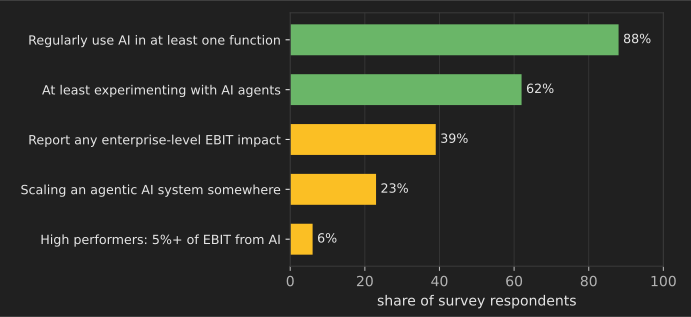
The pattern behind the examples below is the same: the industries furthest along picked a narrow, frequent, measurable task, kept a human responsible for the result, and redesigned the workflow around it.
Healthcare and life sciences
1. Ambient AI scribes write the clinical note
What changed: software listens to the doctor-patient conversation (with consent) and drafts the visit note for the clinician to review, replacing hours of after-hours typing.
The evidence: at Kaiser Permanente's Permanente Medical Group, 7,260 physicians used ambient scribes across about 2.5 million encounters between October 2023 and December 2024, saving an estimated 15,791 hours of documentation, according to the group's analysis reported by the American Medical Association. A randomized trial at UCLA with 238 physicians found a smaller effect: one product cut note-writing time by about 9.5% more than usual care, the other's effect was not statistically significant, and both modestly improved burnout scores (UCLA Health).
What to watch: physicians in the UCLA trial reported occasional clinically significant inaccuracies, most often omissions. The note still needs a careful read.
2. AI reads more medical images, with national trials testing it
What changed: AI tools for radiology moved from pilots to routine use, and health systems are now running large trials to see whether AI can replace one of the two human readers in screening.
The evidence: the U.S. Food and Drug Administration's list of AI-enabled medical devices passed roughly 1,450 authorizations by the end of 2025 by independent counts, about three-quarters in radiology. In England, the EDITH trial, announced in February 2025 with £11 million in funding, is testing AI in breast screening for around 700,000 women.
What to watch: authorization is not the same as proven patient benefit. Many devices were cleared on retrospective data, and results from one country's screening program may not transfer to another.
3. AI-designed drugs reach mid-stage trials
What changed: drug candidates whose target and molecule were both chosen with generative AI are now being tested in patients, not just in silico.
The evidence: in a randomized phase 2a trial of 71 patients with idiopathic pulmonary fibrosis, Insilico Medicine's rentosertib, an AI-discovered TNIK inhibitor, met its primary goal of acceptable safety over 12 weeks, and in an exploratory analysis the 60 mg group's lung function (forced vital capacity) rose by a mean of 98.4 mL while the placebo group's fell by 20.3 mL (Xu et al., Nature Medicine, 2025). Isomorphic Labs, spun out of Google DeepMind, told Reuters in January 2026 that it expected its first clinical trials by the end of 2026, later than its earlier target.
What to watch: a 12-week, 71-person trial is a signal, not proof of efficacy. The real test of AI drug discovery is whether more candidates succeed in phase 3 than the historical average.
Finance and insurance
4. Banks put AI assistants in front of millions of customers and every employee
What changed: consumer banking assistants now handle routine requests at huge volume, and large banks have rolled out internal generative AI tools to most staff.
The evidence: Bank of America says 20.6 million clients interacted with its Erica assistant nearly 700 million times in 2025, and more than 3.2 billion times since 2018 (Bank of America, March 2026, company figures). JPMorgan Chase gave its LLM Suite, a portal to several large language models, to more than 200,000 employees for drafting, summarizing and research (NBC News).
What to watch: interaction counts measure use, not value. Banks rarely publish how often an assistant fully resolved a request or got it wrong.
5. Insurers use agents to settle simple claims in hours
What changed: multi-agent systems now check coverage, verify events and calculate payouts for small, high-volume claims, with a human approving the payment.
The evidence: Allianz Australia's Project Nemo, launched in July 2025, uses seven specialized agents to process food-spoilage claims under AUD 500 after storms, covering planning, coverage checks, weather verification, fraud screening, payout calculation and audit. Allianz says it can cut processing and settlement time by around 80%, and a claims professional makes the final payment decision (Allianz, company figures).
What to watch: these systems start with low-value, rule-bound claims. Larger or disputed claims involve judgment, negotiation and regulatory obligations that agents do not yet handle.
Retail and commerce
6. Shopping assistants drive sales, but agentic checkout stumbles
What changed: conversational assistants now answer product questions inside retail apps, and AI companies tried to let shoppers buy directly inside a chatbot.
The evidence: Amazon said on its Q3 2025 earnings call that about 250 million customers used its Rufus assistant in 2025 and that Rufus was on track to deliver over $10 billion in incremental annualized sales, measured with Amazon's own attribution method (Fortune). By contrast, OpenAI scaled back its Instant Checkout inside ChatGPT in March 2026 and moved to sending shoppers to merchants' own apps and sites, after limited merchant uptake (Forrester).
What to watch: assistants inside a store's own app have shown results. Agents that shop across many retailers face harder problems: payments, returns, liability and merchants' reluctance to give up the customer relationship.
Manufacturing
7. Humanoid robots finish their first long factory deployment
What changed: general-purpose humanoid robots moved from demos to months-long work on a real production line.
The evidence: Figure AI says its Figure 02 robots worked 10-hour shifts at BMW's Spartanburg plant for 11 months, loading more than 90,000 sheet-metal parts over 1,250+ hours and contributing to the production of more than 30,000 BMW X3s, before being retired in favor of a newer model (Figure AI, company figures).
What to watch: one task, at one plant, by the robot's maker. Cost per part compared with a conventional fixed robot or a human worker has not been published.
8. "Lighthouse" factories combine AI with digital twins
What changed: the most advanced factories now use generative AI, computer vision and digital twins (live virtual models of a plant) across operations instead of in isolated pilots.
The evidence: the World Economic Forum's Global Lighthouse Network added 23 sites in January 2026. One, ACG's packaging-materials plant in Shirwal, India, reported 71% fewer defects, 40% shorter lead times and 31% lower energy use. A June 2026 cohort brought the network to 238 sites.
What to watch: lighthouse results are self-reported by the companies and reviewed by the Forum's partners; they describe the leaders, not a typical factory.
Transportation and logistics
9. Warehouse robot fleets run on a foundation model
What changed: instead of programming robot traffic by hand, large operators now train models that coordinate thousands of robots at once.
The evidence: Amazon deployed its millionth robot in July 2025 and introduced DeepFleet, a generative AI model that it says improves the travel efficiency of its robot fleet by 10% (Amazon, company figures).
What to watch: efficiency gains change the number and type of warehouse jobs. Amazon says robots take over repetitive tasks and create technical roles; the net effect on employment is not something the company has published.
10. Freight brokers hand quoting and order entry to agents
What changed: the email-heavy back office of freight brokerage, such as reading requests, quoting prices, creating orders and booking appointments, is being handled by generative AI agents.
The evidence: C.H. Robinson said in April 2025 that its AI agents had performed more than 3 million shipping tasks, including well over 1 million price quotes and 1 million orders (C.H. Robinson, company figures).
What to watch: brokerage margins are thin, so the gains show up as higher shipments per employee, and headcount in these roles is likely to keep shrinking.
11. Robotaxis scale to hundreds of thousands of paid rides a week
What changed: fully driverless ride-hailing became a real business in multiple U.S. cities rather than a pilot.
The evidence: Waymo said it reached about 500,000 paid rides per week across 10 U.S. cities in spring 2026, double its April 2025 level, and it began fully driverless operations in Las Vegas in July 2026 (Electrek). A study with insurer Swiss Re covering 25.3 million miles found far fewer property-damage and bodily-injury claims than for human drivers (Waymo).
What to watch: the safety data come largely from Waymo or its partners, and robotaxis still struggle with rare events such as emergency scenes and flooded roads.
12. Driverless trucks haul commercial freight
What changed: heavy trucks began carrying customer loads on public highways with no one in the cab.
The evidence: Aurora launched commercial driverless trucking between Dallas and Houston in May 2025 with customers including Uber Freight and Hirschbach (TechCrunch), and later extended its network toward El Paso and Phoenix.
What to watch: routes are limited to well-mapped highways in good weather, and the economics depend on running trucks far more hours per day than human hours-of-service rules allow.
13. Airlines plan routes that save fuel
What changed: AI suggests flight routes and altitudes that avoid weather and congestion, and dispatchers choose whether to use them.
The evidence: Alaska Airlines says routes optimized with Air Space Intelligence's Flyways platform saved over 1.2 million gallons of fuel in a year, with 3 to 5% fuel savings on flights longer than four hours (Alaska Airlines, company figures).
What to watch: every route still needs a dispatcher's decision and air traffic control approval; the AI widens options rather than flying the plane.
Agriculture, weather and energy
14. Smart sprayers cut herbicide use
What changed: cameras on sprayer booms identify weeds in real time, and nozzles spray only the weeds instead of the whole field.
The evidence: John Deere says See & Spray was used on more than 5 million acres in 2025 and cut non-residual herbicide use by an average of nearly 50%, about 31 million gallons of spray mix (John Deere, company figures).
What to watch: savings depend on weed pressure, and the equipment is expensive; Deere now sells it on a per-acre fee to lower the upfront cost.
15. Machine learning forecasts go operational
What changed: a major weather center now runs AI forecasts alongside its physics-based models every day.
The evidence: the European Centre for Medium-Range Weather Forecasts made its AI Forecasting System operational in February 2025 and an AI ensemble of 51 forecasts operational on 1 July 2025. ECMWF says the ensemble beats its physics-based ensemble by up to 20% on some measures and uses about 1,000 times less energy to run, though at coarser 31 km resolution (ECMWF).
What to watch: AI models are trained on decades of physics-based reanalysis data, so they do not replace the physics models; ECMWF is developing hybrids of the two.
16. AI reshapes electricity demand
What changed: AI is now a major new source of electricity demand, which pushes utilities to plan new generation and grid capacity.
The evidence: the International Energy Agency's Energy and AI report projects data-center electricity use to more than double from about 415 TWh in 2024 to around 945 TWh by 2030, with AI the main driver and the United States accounting for nearly half of demand growth there.
What to watch: the IEA stresses large uncertainty in these projections, which depend on chip efficiency, model design and how much AI use actually grows.
Software, customer service and security
17. AI writes a large share of new code
What changed: coding assistants and agents now draft, test and refactor much of the software at large tech companies.
The evidence: Alphabet CEO Sundar Pichai said in April 2025 that "well over 30%" of new code at Google was generated with AI and accepted by engineers. In the 2025 Stack Overflow Developer Survey, 84% of respondents used or planned to use AI tools, but 46% distrusted their accuracy and only 33% trusted it. A randomized trial by METR with 16 experienced open-source developers found that early-2025 AI tools made them 19% slower on their own repositories, even though they believed they were faster.
What to watch: gains depend heavily on the task, the codebase and the developer's experience. Measure cycle time and defect rates, not lines of AI-generated code.
18. Customer service automation, and its reversals
What changed: AI agents now resolve a large share of routine support conversations, and some companies cut support headcount as a result.
The evidence: Klarna said in February 2024 that its AI assistant handled two-thirds of customer chats in its first month, the work of about 700 full-time agents (Klarna, company figures). In 2025 its CEO said the push had gone too far on quality and the company began hiring human agents again (Tech.co). Salesforce CEO Marc Benioff said in August 2025 that support headcount had fallen from about 9,000 to about 5,000 as AI agents took on roughly half of conversations; Salesforce described it as not backfilling roles and redeploying staff (Salesforce Ben).
What to watch: containment rates are easy to raise by making it hard to reach a person. Track resolution, repeat contacts and customer satisfaction alongside cost.
19. AI finds and fixes software vulnerabilities, and attackers use it too
What changed: autonomous systems can now find and patch bugs in real code, and attackers have used AI agents to run much of an intrusion.
The evidence: in the final of DARPA's AI Cyber Challenge in August 2025, teams' autonomous systems found 86% of the competition's synthetic vulnerabilities and patched 68% of those found, and discovered real, previously unknown flaws (DARPA). In November 2025, Anthropic reported disrupting an espionage campaign it attributed to a Chinese state-sponsored group, in which its Claude Code tool performed an estimated 80 to 90% of tactical operations with humans directing strategy (Anthropic).
What to watch: both defense and offense are speeding up. Patch management, logging and identity controls matter more when attacks can be run at machine speed.
20. Telecom operators use AI against scammers
What changed: carriers use AI to detect scam calls and messages, and in one case to waste fraudsters' time.
The evidence: Virgin Media O2 launched "Daisy," an AI voice persona of a chatty grandmother, in November 2024 to keep phone scammers on the line; O2 said by early 2025 she had spoken with more than 1,000 scam callers, some for 40 minutes (Virgin Media O2).
What to watch: Daisy is partly an awareness campaign. Scale defense comes from network-level spam filtering and call blocking, while scammers adopt voice cloning of their own.
Professional services, education and media
21. Lawyers and consultants adopt AI, and courts sanction fabricated citations
What changed: legal research and drafting tools are now common in law firms and consultancies, and so are errors when outputs are not checked.
The evidence: researcher Damien Charlotin's AI Hallucination Cases database tracks court decisions involving AI-fabricated citations and had logged well over 1,000 cases worldwide by mid-2026. In October 2025, Deloitte agreed to partially refund the Australian government for a AU$440,000 report that contained a fabricated court quotation and references to papers that do not exist; a revised version disclosed the use of Azure OpenAI (AP via CTV News).
What to watch: professional responsibility does not transfer to the tool. Every citation and quotation needs checking against the source.
22. AI tutors show strong results, when they are designed to teach
What changed: most students now use AI for school, and well-designed AI tutors have outperformed classroom instruction in controlled trials.
The evidence: the 2026 AI Index reports that over 80% of U.S. high school and college students use AI for school tasks. In a Harvard randomized trial with 194 physics students, a custom AI tutor produced larger learning gains in less time than an active-learning class (Kestin et al., Scientific Reports, 2025). But a field experiment with about 1,000 Turkish high school students found that unrestricted GPT-4 access improved practice scores and then lowered exam scores by 17% once it was taken away (Bastani et al., PNAS, 2025).
What to watch: the difference between help and harm was the design: tutors that guide students to the answer, versus tools that hand it over.
23. Studios put generative AI on screen
What changed: generative video moved from previsualization into finished film and television.
The evidence: Netflix said in July 2025 that its Argentine series El Eternauta contained its first on-screen generative AI visual effects, a building collapse that co-CEO Ted Sarandos said was completed 10 times faster than with traditional tools (Reuters via Business Standard). Video game performers ended an 11-month strike in July 2025 with a contract requiring consent and disclosure for AI digital replicas of their voices and likenesses (AWN).
What to watch: consent, compensation and credit for performers and artists whose work trains or appears in AI output remain the central disputes.
24. Advertising moves toward fully automated campaigns
What changed: ad platforms now generate ad variations and choose audiences automatically, and brands are testing fully AI-produced commercials.
The evidence: the Wall Street Journal reported in June 2025 that Meta aims to let advertisers fully create and target ads with AI by the end of 2026, from a product image and a budget (Campaign Asia). Coca-Cola's 2025 AI-generated holiday commercial drew heavy online criticism for its visual glitches and for replacing human craft, even as the company defended the approach (TechRadar).
What to watch: brand safety, creative control and audience reaction. Cheaper production does not help if the work damages the brand.
Science and government
25. AI accelerates research and public administration
What changed: AI systems now contribute to scientific discoveries and are being rolled out to civil servants for everyday work.
The evidence: the 2024 Nobel Prize in Chemistry went partly to Demis Hassabis and John Jumper for AlphaFold's protein structure prediction (Nobel Prize). In May 2025, Google DeepMind's AlphaEvolve agent found a scheduling heuristic that recovers about 0.7% of Google's worldwide compute and a way to multiply 4×4 complex matrices with 48 multiplications, improving on a 1969 result (Google DeepMind). In the UK, a trial with about 20,000 civil servants found self-reported savings of 26 minutes a day with Microsoft 365 Copilot (GOV.UK), while a separate Department for Business and Trade evaluation found time savings but no evidence of improved productivity (DBT evaluation).
What to watch: self-reported time savings are the weakest form of evidence. Scientific claims are checked by replication; workplace claims should be checked with controlled comparisons.
What the 25 examples have in common
- The task is narrow and frequent. Notes, claims under AUD 500, price quotes, weed detection and robot traffic are repeated millions of times, so small gains add up and errors can be counted.
- A human stays accountable. Doctors sign notes, claims staff approve payouts, dispatchers choose routes. Where that check was skipped, as with fabricated legal citations, the failures were public.
- The workflow changed, not just the tool. McKinsey's high performers were far more likely to redesign workflows than to bolt AI onto existing ones.
- Rigorous evidence is still scarce. Only a few examples here (scribes, tutors, coding) have randomized trials, and those trials found smaller or more mixed effects than company announcements.
- Reversals are part of the story. Klarna's support rehiring and OpenAI's checkout retreat show that early claims can be revised within a year.
How to evaluate an "AI transformed our industry" claim
- Who measured it? The vendor, the customer, or an independent researcher?
- Compared with what? The old process, a human, a simpler model, or nothing?
- Is it usage or outcome? "700 million interactions" is usage; "resolved without a repeat contact" is an outcome.
- Average or best case? "Up to 80%" describes the best case.
- What happened to errors and quality? Faster output with more mistakes can cost more than it saves.
- Who carries the risk when it is wrong? Patients, customers, employees, or the company?
- Has it lasted? Check whether the program still exists a year later.
Where to go next
- Go deeper by sector in 30 AI applications in healthcare, finance and education and 50 AI use cases in manufacturing, retail and logistics.
- See how AI changes the functions inside every company in 40 ways AI is changing business operations, marketing and sales.
- See what the evidence says about jobs and skills in 75 examples of how AI is changing the future of work.
- For the established machine learning behind many of these systems, read 100 machine learning applications across industries and 100 machine learning algorithms explained.
References
Sources are linked in each entry. Broader references:
- Stanford Institute for Human-Centered AI (2026). AI Index Report 2026. hai.stanford.edu/ai-index/2026-ai-index-report
- McKinsey & Company (November 2025). The state of AI in 2025: Agents, innovation, and transformation. mckinsey.com
- McKinsey & Company (2026). The state of AI in 2026: On the road to ROI. mckinsey.com
- International Energy Agency (April 2025). Energy and AI. iea.org/reports/energy-and-ai
- Xu, Z., et al. (2025). "A generative AI-discovered TNIK inhibitor for idiopathic pulmonary fibrosis: a randomized phase 2a trial." Nature Medicine. doi.org/10.1038/s41591-025-03743-2
- Kestin, G., Miller, K., et al. (2025). "AI tutoring outperforms in-class active learning: an RCT introducing a novel research-based design in an authentic educational setting." Scientific Reports, 15. doi.org/10.1038/s41598-025-97652-6
- Bastani, H., et al. (2025). "Generative AI without guardrails can harm learning: Evidence from high school mathematics." PNAS, 122(26). doi.org/10.1073/pnas.2422633122
- Becker, J., Rush, N., et al. (2025). "Measuring the Impact of Early-2025 AI on Experienced Open-Source Developer Productivity." METR. metr.org
- U.S. Food and Drug Administration. "Artificial Intelligence-Enabled Medical Devices." fda.gov