A personal finance rule of thumb is a simple guideline that gets most people close to a good decision without a spreadsheet. Rules like "save 15% for retirement" or "keep three to six months of expenses in cash" are popular because they are easy to remember and act on. They are also easy to misuse, because every rule hides assumptions about income, age, interest rates and goals.
This guide covers 15 rules worth following for financial stability. For each one you get where it comes from, the math behind it, and when it breaks, so you know when to adapt it rather than follow it blindly.
The short answer. Spend less than you earn, keep a cash buffer, avoid high-interest debt, save automatically for retirement, invest in low-cost diversified funds, and protect yourself from big losses and scams. The rules below put numbers on each of those.
How we wrote this. Each rule is traced to its original source where one exists, such as a book, a research paper or a published guideline from a regulator or large financial firm. Worked examples are our own calculations, with assumptions stated. U.S. figures are checked as of 25 October 2026. This is general education, not personal financial advice.
Rules at a glance
| # | Rule | One-line version |
|---|---|---|
| 1 | Spend less than you earn | Positive cash flow every month |
| 2 | Emergency fund | Three to six months of essential expenses in insured cash |
| 3 | 50/30/20 | Needs, wants and savings as shares of take-home pay |
| 4 | Pay yourself first | Save on payday, before you spend |
| 5 | Never skip the match | Contribute enough to get the full employer match |
| 6 | Save 15% for retirement | Including the employer match |
| 7 | Pay cards in full | Never carry a balance at 20%+ interest |
| 8 | High-interest debt before investing | Compare the debt's rate with likely returns |
| 9 | Housing under 30% | The federal "cost burden" line |
| 10 | Rule of 72 | 72 ÷ rate ≈ years to double |
| 11 | Keep costs low | Fees compound against you |
| 12 | Match money to time horizon | Short-term money stays out of stocks |
| 13 | Retirement savings by age | 1x salary by 30, 10x by 67 |
| 14 | The 4% rule | Spend about 4% of savings in year one of retirement |
| 15 | Too good to be true | Verify before you invest |
Rules for cash flow and safety
1. Spend less than you earn
The rule. Every month, your spending should be lower than your take-home pay. The difference, your surplus, is what you save, invest or use to repay debt.
Why it works. Every other rule depends on this one. Without a surplus there is nothing to save, and shortfalls are covered by borrowing, which makes next month's surplus smaller still.
When it breaks. Short periods of negative cash flow can be planned and fine: a student living on savings, a parent on unpaid leave, a retiree drawing down investments. What matters is that the gap is deliberate and funded, not covered by a credit card by default.
2. Keep three to six months of essential expenses in an emergency fund
The rule. Hold enough cash to cover three to six months of essential expenses. Fidelity's guideline suggests starting with $1,000 or one month of essentials, whichever is more, then building up to three to six months (Fidelity).
Why it works. Most financial setbacks are temporary: a lost job, a medical bill, a broken car. Cash turns them into an inconvenience instead of a debt. In the Federal Reserve's October 2025 survey, 63% of U.S. adults said they would cover a $400 emergency expense with cash or its equivalent (Federal Reserve, 2026); the rest would need to borrow, sell something, or could not pay.
When it breaks. If your income is irregular, you are self-employed, or your household has one earner, aim for six months or more. If you have very stable income and other liquid reserves, three months may be enough. The CFPB does not prescribe a fixed amount and suggests basing it on the unexpected costs you have actually faced (CFPB).
3. Use the 50/30/20 rule as a starting budget
The rule. Split take-home pay into 50% needs (housing, groceries, utilities, insurance, minimum debt payments), 30% wants and 20% savings and extra debt repayment. The framework was popularized by Elizabeth Warren and Amelia Warren Tyagi in their 2005 book All Your Worth, which divides money into "must-haves", "wants" and savings.
Example. On $4,000 a month after tax: $2,000 for needs, $1,200 for wants, $800 for savings.
When it breaks. In high-cost cities, needs alone can exceed 50%. That is a signal to look at housing and transport first, not a reason to abandon saving. Fidelity's current guideline uses a different split, 60% essentials, 30% nice-to-haves and 10% near-term savings from take-home pay, plus 15% of pre-tax pay for retirement (Fidelity). Our budgeting methods guide compares these splits and 18 other approaches.
4. Pay yourself first
The rule. Move money to savings and investments automatically on payday, then spend what is left.
Why it works. Saving becomes the default, and defaults are powerful. When one large U.S. company switched its 401(k) from opt-in to automatic enrollment, participation rose substantially and many workers kept the default contribution rate and investment (Madrian and Shea, NBER).
When it breaks. If automatic transfers keep pushing your checking account into overdraft, the transfer is too large for your cash flow. Lower it, fix the budget, then raise it again.
Rules for retirement saving
5. Never leave the employer match on the table
The rule. If your employer matches retirement contributions, contribute at least enough to get the full match.
Example. With a 50% match on the first 6% of a $50,000 salary, you contribute $3,000 a year and receive $1,500 from your employer. That is a 50% return on your contribution before any investment growth.
When it breaks. Rarely. If you are in a true cash emergency, or the match vests only after several years and you are sure you will leave before then, it may be less valuable. Check your plan's vesting schedule.
6. Save about 15% of pre-tax income for retirement
The rule. Fidelity suggests saving 15% of pre-tax income each year for retirement, including any employer match (Fidelity). For reference, Vanguard's How America Saves 2026 report found that participants in its plans contributed an average of 12.1% including employer contributions in 2025 (Vanguard).
Why it works. Fidelity's estimate assumes you start at 25 and retire at 67. Starting later means you need a higher rate to catch up.
When it breaks. Someone with a generous pension, or who starts saving at 40, needs a different number. Treat 15% as a floor to aim for in your 20s and 30s, not a universal answer. In the U.S., 2026 limits are $24,500 for 401(k)-type plans and $7,500 for IRAs (IRS).
Rules for debt
7. Pay credit cards in full every month
The rule. Treat a credit card as a payment tool, not a loan. Pay the statement balance in full by the due date.
Why it works. The average rate on U.S. card accounts that were charged interest was 22.36% in August 2026 (Federal Reserve G.19). A $5,000 balance paid down at $150 a month at that rate takes 53 months and costs about $2,886 in interest (our calculation). Paying in full each month avoids interest entirely on most cards, and payment history is the largest part of a FICO score, about 35% (myFICO).
When it breaks. A genuine 0% introductory offer can be a useful tool if you know the balance will be gone before the promotional rate ends. Read the terms carefully.
8. Pay off high-interest debt before investing extra
The rule. After the emergency fund and employer match, put extra money toward debt whose interest rate is higher than you can reasonably expect from investing.
Why it works. Paying off a 22% card is a guaranteed 22% return. No mainstream investment reliably beats that.
When it breaks. The line is fuzzy for mid-rate debt (roughly 5% to 8%), where reasonable people choose differently. Low-rate debt, such as a fixed-rate mortgage at 3%, is usually fine to pay on schedule while you invest. Whatever you choose, keep paying every debt on time.
9. Keep housing costs under about 30% of income
The rule. U.S. federal housing policy treats housing as "affordable" if it costs no more than 30% of household income; households paying more are considered cost burdened, and those paying more than half are severely cost burdened (Congressional Research Service, May 2026).
Why it works. Housing is usually the largest single expense and the hardest to change quickly. Keeping it in check leaves room for everything else.
When it breaks. The 30% line comes from public housing policy, not personal finance research, and it does not vary with income. For lower incomes, 30% may leave too little for other needs; for high incomes, more than 30% may be manageable. Many renters cannot find housing below 30% at all, so use it as a warning sign rather than a pass/fail test. Lenders use their own debt-to-income limits, which vary by loan product (CFPB).
Rules for investing
10. The Rule of 72
The rule. Divide 72 by the annual growth rate to estimate how many years it takes money to double.
Example. At 6% a year, money doubles in about 72 ÷ 6 = 12 years; the exact answer is 11.9 years. At 10%, the rule gives 7.2 years; the exact answer is 7.3. It also works for inflation: at 3.7% inflation, prices double in about 19 years.
When it breaks. It is an approximation that works best between roughly 5% and 10%. At very high rates it is less accurate, and it assumes a steady rate, while real investment returns vary a lot from year to year.
11. Keep investment costs low
The rule. Prefer low-cost, diversified funds, and pay attention to every fee: fund expense ratios, advisory fees, and trading costs.
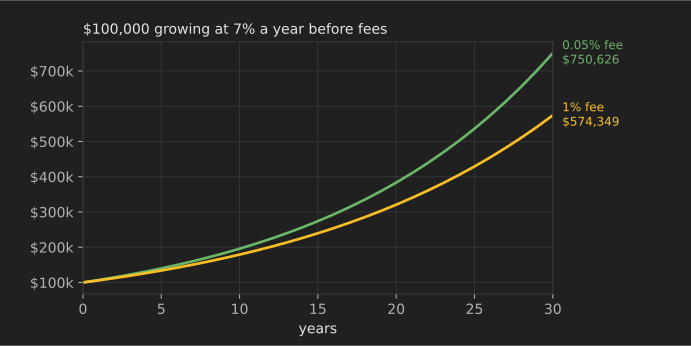
Why it works. Fees compound against you just as returns compound for you. $100,000 growing at 7% a year for 30 years ends at about $750,600 with a 0.05% annual fee, but about $574,300 with a 1% fee, a difference of more than $176,000 (our calculation). Cost also helps explain why most active funds trail their benchmarks: in the first half of 2026, 67% of actively managed U.S. large-cap funds underperformed the S&P 500, after 79% in 2025 (S&P Dow Jones Indices).
When it breaks. Paying for advice can be worth it if it changes your behavior, for example by stopping you from selling in a panic or by handling complex tax planning. The question is whether you get value for the fee.
12. Match your investments to your time horizon
The rule. Money you will need within the next few years (an emergency fund, a house deposit, next year's tuition) should be in cash or other stable, low-risk savings. Money you will not touch for many years can take more risk for higher expected returns.
Why it works. Stocks can fall sharply and take years to recover. Long horizons give time to recover; short horizons do not. The SEC's investor education site describes asset allocation, dividing money between stocks, bonds and cash, as a choice that depends mainly on your time horizon and your ability to tolerate risk (Investor.gov).
When it breaks. There is no exact cutoff year. A common practical line is "money needed within about five years stays out of stocks", but your own comfort with risk matters too.
13. Retirement savings benchmarks by age
The rule. Fidelity suggests aiming to have saved about 1x your salary by 30, 3x by 40, 6x by 50, 8x by 60 and 10x by 67 (Fidelity).
Why it works. It turns a vague goal into a checkpoint. The milestones assume you save 15% of income a year from age 25, retire at 67, keep a similar lifestyle in retirement, and keep more than half of your savings in stocks on average over your lifetime.
When it breaks. If you expect a pension, plan to retire early, or plan to spend much less in retirement, the targets change. Being behind at 30 is common and not a disaster; the fix is to raise the savings rate, not to take risky bets to catch up.
14. The 4% rule for retirement withdrawals
The rule. In the first year of retirement, withdraw about 4% of your portfolio, then increase that dollar amount with inflation each year. Turned around, it suggests you need roughly 25 times your annual spending from investments.
Where it comes from. Financial planner William Bengen published "Determining Withdrawal Rates Using Historical Data" in the Journal of Financial Planning in October 1994. Using U.S. data for a portfolio of 50% stocks and 50% intermediate-term Treasuries, he found that a 4% initial withdrawal, adjusted for inflation, lasted at least about 33 years in every historical period he examined (Rob Berger's summary of the paper).
Example. With $1,000,000 saved, the first-year withdrawal is $40,000. To spend $40,000 a year from investments, you would need about $40,000 × 25 = $1,000,000.
When it breaks. Bengen intended 4% as a worst-case floor based on past U.S. returns, not a guarantee; in his 2025 book A Richer Retirement, using more asset classes, he puts the historical worst case at about 4.7% and argues that many retirees can safely spend more (Advisor Perspectives, August 2025). The rule ignores fees and taxes, assumes a 30-year retirement, and uses history that may not repeat. Early retirees with 40- or 50-year horizons usually plan for a lower rate. Researchers such as Karsten Jeske at Early Retirement Now have written long series on these limits.
A rule for protecting yourself
15. If it sounds too good to be true, verify before you invest
The rule. Be skeptical of any investment that promises high returns with little or no risk, pressures you to act quickly, or reaches you through an unexpected message or a new online contact.
Why it matters. In 2025, U.S. consumers reported $15.9 billion in fraud losses to the Federal Trade Commission, and investment scams were the largest category by losses, at over $7.9 billion (FTC, March 2026). The FTC notes that reported losses are only a fraction of the true total.
How to apply it. Check whether a broker or adviser is registered using FINRA's free BrokerCheck. Never move money because of a message you did not expect, never pay with gift cards or crypto at someone else's request, and talk to someone you trust before any large transfer.
How to use these rules together
The rules are roughly in priority order. A practical sequence for most people:
- Get to positive cash flow (rule 1) and build a starter emergency fund (rule 2).
- Contribute enough to get the full employer match (rule 5).
- Pay off credit cards and other high-interest debt (rules 7 and 8).
- Finish the full emergency fund (rule 2).
- Raise retirement saving toward 15% (rule 6) in low-cost funds (rule 11), with the right mix for your time horizon (rule 12).
- Check your progress against the age benchmarks once a year (rule 13).
For more specific actions, read our 25 money management tips for 2026; for the routines that keep these rules working, see 30 smart money habits. To read more from people who write about these trade-offs, browse the Personal Finance blogs in our directory.
FAQ
Are personal finance rules of thumb reliable?
They are reliable as starting points, not as personal plans. Each one has assumptions about your age, income, interest rates and goals. Use them to spot problems, such as housing at 45% of income or no emergency savings, and adjust the numbers to your situation.
What is the most important personal finance rule?
Spend less than you earn. Without a monthly surplus, you cannot build savings, pay down debt or invest, and every other rule depends on it.
Is the 4% rule still valid in 2026?
It remains a widely used starting point, but its author called it a conservative floor based on historical U.S. data, and it assumes a 30-year retirement without fees or taxes. Early retirees and people with very different portfolios should plan with more care, ideally with a fee-only planner.
References
All accessed 25 October 2026.
- Fidelity Investments. Fidelity's easy budgeting guideline; How much do I need to retire?.
- Board of Governors of the Federal Reserve System. Economic Well-Being of U.S. Households in 2025, press release (13 May 2026); G.19 Consumer Credit (7 October 2026).
- Consumer Financial Protection Bureau. An essential guide to building an emergency fund; What is a debt-to-income ratio?.
- Warren, E. and Warren Tyagi, A. (2005). All Your Worth: The Ultimate Lifetime Money Plan. Free Press.
- Madrian, B. and Shea, D. (2001). The Power of Suggestion: Inertia in 401(k) Participation and Savings Behavior. Quarterly Journal of Economics 116(4).
- Vanguard. How America Saves 2026 (data as of year-end 2025).
- Internal Revenue Service. 401(k) limit increases to $24,500 for 2026, IRA limit increases to $7,500 (13 November 2025).
- myFICO. What's in my FICO Scores?.
- Congressional Research Service. Housing Cost Burdens in 2024: In Brief (R48945, 13 May 2026).
- S&P Dow Jones Indices. SPIVA U.S. Mid-Year 2026 Scorecard.
- U.S. Securities and Exchange Commission, Investor.gov. Asset Allocation.
- Bengen, W. (1994). "Determining Withdrawal Rates Using Historical Data." Journal of Financial Planning, October 1994; summarized by Rob Berger. See also Advisor Perspectives, Bill Bengen Boosts the "4% rule" to 4.7% (29 August 2025).
- Federal Trade Commission. Testimony before the Joint Economic Committee on the rising scam economy (25 March 2026).
- FINRA. BrokerCheck.