Money management is the everyday work of deciding where your income goes: what you spend, what you save, what you owe and what you invest. Done well, it gives you a cushion for bad months and a growing balance for the long term. This guide collects 25 practical tips for 2026, ordered roughly from "do this first" to "do this once the basics work", with worked numbers so you can see why each one matters.
The short answer. Know where your money goes, keep a cash buffer, pay off high-interest debt, automate saving before you spend, and invest for the long term in low-cost diversified funds. Everything else is detail.
How we wrote this. Figures for 2026, such as account limits, inflation and card interest rates, come from the IRS, the U.S. Bureau of Labor Statistics and the Federal Reserve, checked on 25 October 2026. The worked examples are our own calculations with the assumptions stated next to them. Account names and limits are U.S.-specific; most countries have equivalents (for example ISAs and workplace pensions in the UK, the EPF, PPF and NPS in India, or the RRSP and TFSA in Canada), so look up your local rules. This article is general education, not personal financial advice; for decisions with tax or legal consequences, talk to a qualified, fee-only adviser.
Where things stand in 2026
A few numbers frame this year's money decisions:
- Prices are still rising. U.S. consumer prices were 3.7% higher in September 2026 than a year earlier, and 2.6% higher excluding food and energy (BLS, 14 October 2026). Cash that earns nothing loses buying power.
- Card debt is expensive. The average interest rate on credit card accounts that were charged interest was 22.36% in August 2026 (Federal Reserve G.19).
- Many households have thin buffers. In the Federal Reserve's survey of October 2025, 63% of U.S. adults said they would cover a $400 emergency expense with cash or its equivalent, unchanged from the year before (Federal Reserve, May 2026). The other 37% would borrow, sell something or could not pay.
- Saving limits went up. For 2026 the 401(k) employee limit is $24,500 and the IRA limit is $7,500 (IRS, November 2025).
Know your numbers
1. Track every dollar for one month
You cannot manage what you have not measured. For 30 days, record every expense, from rent to coffee, using your banking app's export, a spreadsheet or a notebook. The goal is not to judge yourself but to find the gap between what you think you spend and what you actually spend. Most people find two or three categories (food delivery, subscriptions, rideshares are common) that are much larger than they guessed.
2. Work out your monthly cash flow
Cash flow is income after tax minus all spending. Write down your take-home pay, then your fixed costs (rent, loan payments, insurance, phone), then variable costs (groceries, fuel, going out). If the result is negative, every other tip waits until you fix that. If it is positive, that surplus is the raw material for saving and investing.
3. Calculate your net worth once a quarter
Net worth is everything you own (cash, investments, the value of your home or car) minus everything you owe. It is a better scorecard than income, because it shows whether your money is actually building up. A spreadsheet with one row per account, updated every three months, is enough. A negative net worth early in your career, often from student loans, is common; the direction of change matters more than the number.
4. Know your debt-to-income ratio
The Consumer Financial Protection Bureau defines debt-to-income (DTI) as your total monthly debt payments divided by your gross monthly income (CFPB). In its example, $2,000 of monthly debt payments on $6,000 of gross monthly income gives a DTI of 33%. Lenders use it to decide how much more they will lend you, and you can use it to see how much of your future is already spoken for. Different lenders and loan types set different limits.
Build a safety net
5. Start an emergency fund, even a small one
An emergency fund is cash set aside for surprises: a car repair, a medical bill, a gap between jobs. The CFPB does not prescribe a fixed amount; it suggests looking at the unexpected expenses you have actually had and setting a goal from there, and it notes that even a small amount gives some security (CFPB). A common first target is $500 to $1,000, then one month of essential expenses.
6. Grow it toward three to six months of essentials
Once the starter fund is in place, a widely used target is three to six months of essential expenses, which is the range Fidelity suggests building toward after a starter fund of $1,000 or one month of essentials, whichever is more (Fidelity). If your essentials are $2,500 a month, that is $7,500 to $15,000. Aim for the higher end if your income is irregular, you are self-employed, or you are the only earner in your household.
7. Keep the emergency fund insured and separate
Keep it in a separate savings account so it is not mixed with spending money. In the U.S., deposits at FDIC-insured banks are protected up to $250,000 per depositor, per bank, for each account ownership category; stocks, bonds, mutual funds and crypto assets are not covered by deposit insurance (FDIC). An emergency fund belongs in insured cash, not in investments that can fall just when you need them.
8. Shop around for the interest rate
Savings rates differ widely between banks. At 4% a year, $10,000 earns about $400 in interest; at 0.4% it earns about $40. Online banks and credit unions often pay more than large branch banks. Check that the account is insured and has no monthly fees, and recheck the rate once or twice a year because savings rates move with central bank rates.
Spend on purpose
9. Choose a budgeting method you will actually keep
The best budget is the one you follow. If you like rules, try the 50/30/20 split; if you want control over every dollar, try a zero-based budget; if you hate tracking, try pay yourself first. Our guide to 20 budgeting methods compares them, including methods for irregular incomes.
10. Cut the three biggest costs before the small ones
Housing, transport and food usually take the largest share of spending. A cheaper apartment, a used car instead of a new one, or cooking most dinners can save more in a month than a year of skipped coffees. Start where the money is.
11. Audit your subscriptions
List every recurring charge from your last three statements: streaming, apps, gyms, cloud storage, memberships. Cancel the ones you have not used in the last month. Many people find subscriptions they forgot about; card statements and banking apps make them easy to spot.
12. Use a waiting period for non-essential purchases
For anything that is not a need, wait before buying: 24 hours for small items, 30 days for large ones. Many impulse wants fade, and the ones that do not are probably worth buying. This works especially well for online shopping, where buying takes one tap.
13. Negotiate recurring bills
Call your internet, phone and insurance providers once a year, ask about current offers, and be ready to switch. Compare insurance quotes at renewal rather than letting a policy roll over automatically. A few calls a year can cut fixed costs without changing how you live.
14. Plan for irregular expenses with sinking funds
Car registration, annual subscriptions, holidays and birthdays are predictable, just not monthly. A sinking fund spreads them out: divide each expected annual cost by 12 and set that amount aside every month in a labeled savings bucket. When the bill comes, the money is already there and the budget does not break.
Handle debt well
15. Pay off high-interest debt first
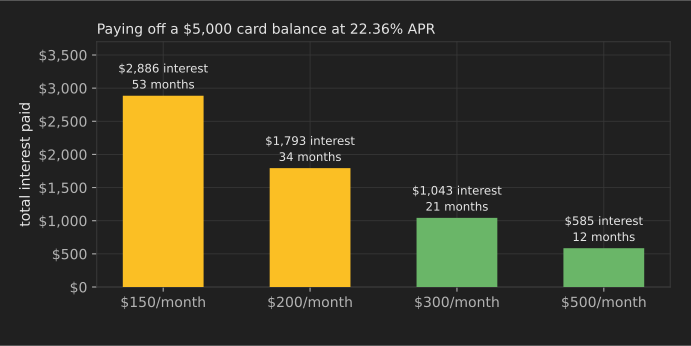
At 22% interest, paying off a credit card is a guaranteed 22% return, better than almost any investment. Paying more than the minimum makes a large difference. Here is a $5,000 balance at the August 2026 average rate of 22.36%, paid off with a fixed monthly payment and no new charges (our calculation):
| Monthly payment | Months to pay off | Total interest |
|---|---|---|
| $150 | 53 | $2,886 |
| $200 | 34 | $1,793 |
| $300 | 21 | $1,043 |
| $500 | 12 | $585 |
16. Pick a payoff order: avalanche or snowball
With several debts, pay the minimum on all of them and put every extra dollar on one:
- Avalanche: highest interest rate first. It costs the least in interest.
- Snowball: smallest balance first. It gives quick wins. A study of more than 6,000 people in a debt settlement program by David Gal and Blakeley McShane found that people who closed out more individual accounts were more likely to eliminate their debt, regardless of the dollar amounts involved (Kellogg School of Management).
If you are disciplined, the avalanche saves money. If you have struggled to stick with a plan, the snowball's early wins may be worth the extra interest.
17. Pay every bill on time
Payment history is the largest factor in a FICO credit score, about 35%, and amounts owed are about 30% (myFICO). Set up automatic payments for at least the minimum on every account so a busy month never turns into a late payment, then pay extra manually.
18. Check your credit reports for free
In the U.S. you can get free credit reports from each of the three nationwide bureaus every week at AnnualCreditReport.com (CFPB). Check them a few times a year for accounts you do not recognize or errors, and dispute mistakes with the bureau. Be careful with look-alike sites that ask you to pay or sign up for a service.
Save and invest automatically
19. Pay yourself first
Set up an automatic transfer to savings or investments on payday, before you have a chance to spend. The CFPB recommends automating savings with recurring transfers or a split direct deposit (CFPB). Behavioral research supports the idea: when a large U.S. company switched to automatic 401(k) enrollment, participation rose sharply and many employees simply kept the default settings (Madrian and Shea, NBER). Use that inertia in your favor.
20. Collect the full employer match
If your employer matches retirement contributions, contribute at least enough to get the full match. With a 50% match on the first 6% of a $50,000 salary, contributing $3,000 a year brings in $1,500 of employer money, an instant 50% return before any investment growth. Check your plan's vesting schedule to know when the match becomes yours.
21. Use tax-advantaged accounts
In the U.S., 2026 contribution limits are $24,500 for 401(k), 403(b) and most 457 plans (plus an $8,000 catch-up at 50 and over, or $11,250 at ages 60 to 63), and $7,500 for IRAs (plus a $1,100 catch-up at 50 and over). Roth IRA eligibility phases out between $153,000 and $168,000 of income for single filers and between $242,000 and $252,000 for married couples filing jointly (IRS). If you have a high-deductible health plan, an HSA allows $4,400 for self-only or $8,750 for family coverage in 2026 (IRS Rev. Proc. 2025-19).
22. Invest in low-cost, diversified funds
For most long-term investors, broad index funds are a sensible core. Over the first half of 2026, 67% of actively managed U.S. large-cap funds trailed the S&P 500, after 79% in 2025, according to S&P Dow Jones Indices' SPIVA scorecard (S&P Global). Low fees matter because they compound too: $100,000 growing at 7% for 30 years becomes about $750,600 with a 0.05% annual fee but only about $574,300 with a 1% fee (our calculation). Our article on 15 personal finance rules charts that gap.
23. Increase your savings rate with every raise
When your pay goes up, direct part of the raise to savings before you get used to spending it. In Richard Thaler and Shlomo Benartzi's "Save More Tomorrow" program, employees committed in advance to save part of future raises; participants' average savings rate rose from 3.5% to 13.6% over about 40 months (Thaler and Benartzi, 2004). Many workplace plans now offer automatic escalation that does this for you.
Protect what you build
24. Insure against the big risks
Insurance is for losses you cannot afford to pay yourself. Priorities for most people are health insurance, liability coverage on cars and homes, disability insurance if you depend on your income, and term life insurance if someone else depends on you. Raising deductibles can lower premiums once your emergency fund can cover the deductible.
25. Guard against scams and fraud
Fraud is now a major money risk. In 2025, U.S. consumers reported $15.9 billion in fraud losses to the Federal Trade Commission, from 3 million reports; investment scams accounted for over $7.9 billion, and impostor scams were the most reported type (FTC testimony, 25 March 2026). Be suspicious of anyone who contacts you unexpectedly and asks for money, gift cards, crypto or a wire transfer; use strong, unique passwords and two-factor authentication on financial accounts; and turn on transaction alerts.
Common mistakes to avoid
- Investing before you have any cash buffer. A surprise bill then forces you to sell investments, possibly at a loss, or to borrow on a card.
- Optimizing small things and ignoring big ones. A cheaper streaming plan will not offset a car payment you cannot afford.
- Carrying a card balance while holding lots of low-interest cash. Beyond your emergency fund, extra cash usually does more good paying off 22% debt.
- Chasing hot investments. The FTC's figures above show how much is lost to investment scams; returns that sound guaranteed and high usually are not real.
- Waiting for a perfect plan. A simple plan started this month beats a detailed one started next year.
A 30-day starter checklist
- Week 1: download last month's transactions and total your spending by category (tips 1 and 2).
- Week 1: list every debt with its balance, rate and minimum payment; set automatic minimum payments (tips 16 and 17).
- Week 2: open a separate savings account and set an automatic transfer on payday, even $25 (tips 5, 7 and 19).
- Week 2: cancel unused subscriptions and call one provider to negotiate (tips 11 and 13).
- Week 3: check your retirement contribution covers the full employer match (tip 20).
- Week 3: pull your credit reports (tip 18).
- Week 4: pick a budgeting method and set next month's plan (tip 9).
For the ongoing routines that keep this working, see 30 smart money habits. If you are just starting out, 10 money management skills to learn in your 20s covers the foundations in more depth. To follow writers who cover these topics regularly, browse the Personal Finance blogs in our directory.
FAQ
What is the first step in managing money?
Find out where your money goes. Track a full month of spending and compare it with your take-home pay. Every other decision, from budgeting to investing, depends on knowing your real cash flow.
Should I save or pay off debt first?
Usually both, in order: build a small emergency fund first so you do not need to borrow again, collect any employer match, then put extra money toward high-interest debt such as credit cards. Low-interest debt, such as many mortgages, can be paid on schedule while you invest.
How much of my income should I save?
There is no single right number. Common guidelines include 20% of take-home pay in the 50/30/20 framework, or Fidelity's current guideline of 15% of pre-tax income for retirement (including any employer match) plus 10% of take-home pay for near-term goals and emergency savings (Fidelity). Start with what you can and raise it over time.
References
All accessed 25 October 2026.
- U.S. Bureau of Labor Statistics. Consumer Price Index News Release, September 2026 (14 October 2026).
- Board of Governors of the Federal Reserve System. G.19 Consumer Credit (7 October 2026).
- Board of Governors of the Federal Reserve System. Economic Well-Being of U.S. Households in 2025, press release (13 May 2026).
- Internal Revenue Service. 401(k) limit increases to $24,500 for 2026, IRA limit increases to $7,500 (IR-2025-111, 13 November 2025).
- Internal Revenue Service. Revenue Procedure 2025-19 (HSA limits for 2026).
- Consumer Financial Protection Bureau. An essential guide to building an emergency fund; What is a debt-to-income ratio?; How do I get a free copy of my credit reports?.
- Federal Deposit Insurance Corporation. Understanding Deposit Insurance.
- myFICO. What's in my FICO Scores?.
- Fidelity Investments. Fidelity's easy budgeting guideline.
- S&P Dow Jones Indices. SPIVA U.S. Mid-Year 2026 Scorecard.
- Madrian, B. and Shea, D. (2001). The Power of Suggestion: Inertia in 401(k) Participation and Savings Behavior. Quarterly Journal of Economics 116(4).
- Thaler, R. and Benartzi, S. (2004). Save More Tomorrow: Using Behavioral Economics to Increase Employee Saving. Journal of Political Economy 112(S1).
- Kellogg Insight. To Beat Debt, Consider Starting Small, on Gal and McShane (2012), Journal of Marketing Research.
- Federal Trade Commission. Testimony before the Joint Economic Committee on the rising scam economy (25 March 2026).