A budget is a plan for your income before you receive it: how much goes to essentials, how much to savings and debt, and how much you can spend freely. There is no single best budgeting method. The right one depends on how much detail you can stand, whether your income is steady, and what you are trying to fix. This guide explains 20 budgeting methods, with a worked example for each, who it suits and its main weakness, so you can pick one and start this month.
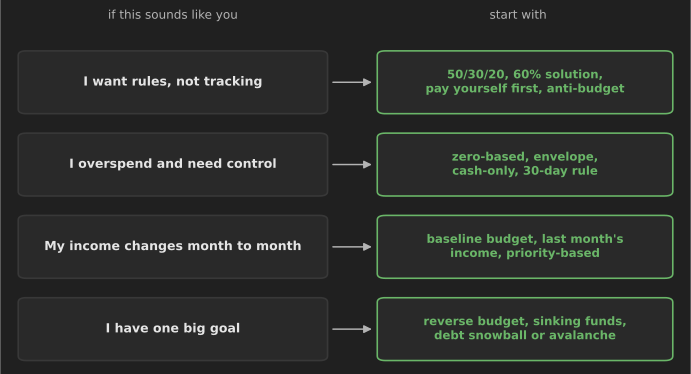
The short answer. If you want something simple, start with 50/30/20 or pay yourself first. If you overspend and need control, use a zero-based or envelope budget. If your income changes from month to month, use a baseline budget or live on last month's income.
How we wrote this. Methods with a known origin are traced to it, such as a book, a published guideline or the person who proposed it. Many popular splits, such as 70/20/10, have no clear single author, and we say so. Every worked example uses $4,000 of monthly take-home pay so you can compare methods directly; the numbers are illustrations, not recommendations for your situation. This is general education, not personal financial advice.
Comparison table
| # | Method | Effort | Best for |
|---|---|---|---|
| 1 | 50/30/20 | Low | Beginners with steady income |
| 2 | 60/30/10 + 15 (Fidelity) | Low | Higher-cost areas, retirement focus |
| 3 | 70/20/10 | Low | Paying down debt or giving |
| 4 | 80/20 | Very low | People who hate tracking |
| 5 | 60% solution | Low | Smoothing irregular bills |
| 6 | Zero-based | High | Overspenders, tight budgets |
| 7 | Envelope (cash) | Medium | Controlling specific categories |
| 8 | Digital envelopes | Medium | Envelope control without cash |
| 9 | Cash-only spending | Medium | Impulse spenders |
| 10 | Pay yourself first | Very low | Consistent savers |
| 11 | Reverse budget | Low | One clear savings goal |
| 12 | Anti-budget | Very low | Stable finances, low debt |
| 13 | Kakeibo | Medium | Reflective, pen-and-paper people |
| 14 | Conscious spending plan | Low | Guilt-free spending on priorities |
| 15 | Sinking funds | Medium | Annual and irregular costs |
| 16 | Priority-based | Medium | Tight or uncertain months |
| 17 | Baseline budget | Medium | Irregular or freelance income |
| 18 | Last month's income | Medium | Breaking the paycheck-to-paycheck cycle |
| 19 | Debt-payoff budget | Medium | Clearing several debts |
| 20 | 30-day rule | Very low | Cutting impulse buys (add-on) |
Percentage-based methods
These methods set rough shares of income instead of tracking every category. They are quick to set up and good for people who want guardrails, not bookkeeping.
1. The 50/30/20 budget
How it works. Split take-home pay into 50% needs, 30% wants and 20% savings and extra debt payments. The idea was popularized by Elizabeth Warren and Amelia Warren Tyagi in their 2005 book All Your Worth, which divides spending into "must-haves", "wants" and savings.
Example. $2,000 needs, $1,200 wants, $800 savings and debt.
Best for. Beginners with steady income who want a simple target.
Watch out for. In expensive cities, needs alone can pass 50%. And "needs" tend to grow to include things that are really wants, so be honest about what is essential.
2. Fidelity's 60/30/10 + 15 guideline
How it works. Fidelity's current budgeting guideline puts 60% of take-home pay toward essentials (housing, groceries, health care, transport, child care and debt payments), 30% toward nice-to-haves and 10% toward near-term goals and emergency savings, plus 15% of pre-tax income for retirement, including any employer match (Fidelity). Fidelity previously promoted a "50/15/5" rule of thumb, which some of its regional sites still describe (Fidelity Canada).
Example. $2,400 essentials, $1,200 nice-to-haves, $400 near-term savings, with retirement taken from pay before it reaches your account.
Best for. People whose essentials do not fit in 50%, or who want retirement saving built in.
Watch out for. The 15% retirement figure is a percentage of pre-tax pay, while the other three are percentages of take-home pay. Keep the two bases separate.
3. The 70/20/10 budget
How it works. 70% for all living expenses (needs and wants together), 20% for savings and investing, 10% for extra debt payments or giving. It is a common variation with no clear single originator.
Example. $2,800 living expenses, $800 savings, $400 debt or giving.
Best for. People who do not want to separate needs from wants, and those with debt to pay down.
Watch out for. Once debt is gone, move the 10% to savings rather than letting it drift into spending.
4. The 80/20 budget
How it works. Save 20% first; spend the other 80% however you like. It is the simplest version of pay yourself first.
Example. $800 to savings on payday, $3,200 for everything else.
Best for. People who hate tracking and already live within their means.
Watch out for. It does nothing to stop overspending within the 80%. If you are carrying card debt, use a more detailed method first.
5. The 60% solution
How it works. Proposed by former MSN Money editor Richard Jenkins, it puts 60% of income into "committed expenses" (housing, food, car payments, utilities, insurance) and splits the rest into four 10% buckets: retirement, long-term savings or debt reduction, irregular expenses, and fun money (The Motley Fool). Descriptions differ on whether the 60% applies to gross or take-home pay; most modern versions use take-home pay.
Example. $2,400 committed, then $400 each to retirement, long-term savings, irregular expenses and fun.
Best for. People whose budgets keep breaking because of irregular bills, which get their own bucket.
Watch out for. If you also save for retirement through payroll, do not count it twice.
Detailed, every-dollar methods
These methods take more effort but give you more control. They work well when money is tight or when you keep overspending without knowing where.
6. Zero-based budget
How it works. Before the month starts, assign every dollar of income to a category (spending, savings or debt) until income minus assignments equals zero. The term comes from corporate budgeting: Peter Pyhrr described "zero-base budgeting" in the Harvard Business Review in 1970, based on his work at Texas Instruments, where every budget item had to be justified from scratch each year (Wikipedia: Peter Pyhrr).
Example. $1,400 rent, $450 groceries, $250 transport, $150 utilities and phone, $300 debt, $500 savings, $200 sinking funds, $350 dining and fun, $400 everything else: total $4,000, leftover $0.
Best for. Overspenders, tight budgets and people paying off debt.
Watch out for. It takes time each month and fails if categories are unrealistic. Include a small "miscellaneous" line so one surprise does not wreck the plan.
7. The envelope system (cash)
How it works. Withdraw cash for variable categories, such as groceries, dining and fun, and put each amount in a labeled envelope. When an envelope is empty, spending in that category stops until next month.
Example. $450 groceries, $200 dining, $150 fun, $100 personal care in four envelopes; rent and bills are paid electronically.
Best for. People who overspend in a few specific categories.
Watch out for. Carrying cash has risks (loss, theft), and many purchases are now online. Keep only variable spending in envelopes.
8. Digital envelopes
How it works. The same idea without cash: separate savings "buckets" at your bank, sub-accounts, or budgeting apps that assign money to categories. Apps such as YNAB build their method around giving each dollar a purpose, setting aside money for irregular costs, and staying about a month ahead on bills (YNAB).
Example. Five sub-accounts for groceries, transport, fun, travel and gifts, each funded automatically on payday.
Best for. People who want envelope control and mostly pay by card.
Watch out for. Subscription costs for apps, and the temptation to "borrow" from one bucket to another every month. Moving money between categories is fine; doing it constantly means the plan needs fixing.
9. Cash-only spending
How it works. Pay for all discretionary spending in cash, without category envelopes. Paying with physical money makes spending more visible than tapping a card.
Example. $800 cash withdrawn on payday covers all non-bill spending for the month.
Best for. Impulse spenders who want friction.
Watch out for. You lose card protections against fraud and disputes, and you cannot build a credit history from cash spending. Keep paying at least one bill on a card or loan if you are building credit.
Save-first methods
These methods focus on getting savings right and worrying less about everything else.
10. Pay yourself first
How it works. On payday, automatically move a fixed amount or percentage to savings and investments. Spend what is left. The CFPB recommends automatic transfers or a split direct deposit as a simple way to build savings (CFPB).
Example. $600 moves to savings and $200 to a retirement account on payday; the remaining $3,200 covers everything else.
Best for. Anyone who saves "whatever is left" and finds nothing is left.
Watch out for. Bills still need paying. If transfers cause overdrafts, the amount is too high for now.
11. Reverse budget
How it works. Start from a goal and work backward. Decide what you need to save and by when, divide it into a monthly amount, automate it, and spend the rest.
Example. A $9,000 house-deposit goal in 18 months needs $500 a month. That $500 moves on payday; the other $3,500 is for living.
Best for. People with one big, specific goal.
Watch out for. It only works if the goal is realistic. If the monthly figure does not fit, extend the timeline rather than skipping months.
12. The anti-budget
How it works. Automate savings and fixed bills, then ignore categories entirely. As long as the checking account does not run out before payday, you are on track.
Example. $800 to savings and $2,100 in bills go out automatically; $1,100 is free to spend.
Best for. People with stable income, no high-interest debt and a solid emergency fund.
Watch out for. It hides slow lifestyle creep. Check your total spending at least every quarter.
13. Kakeibo
How it works. Kakeibo is a Japanese household account book introduced in 1904 by Hani Motoko, often described as Japan's first female journalist (Wikipedia: Kakeibo). At the start of each month you write down income, fixed costs and a savings goal. You record spending by hand in four broad groups, commonly translated as needs, wants, culture and unexpected, and at the end of the month you reflect on how much you saved and what you would change.
Example. Write $4,000 income, $2,000 fixed costs, and a $600 savings goal; log daily spending into the four groups; review the month in a few sentences.
Best for. People who like pen and paper and want to understand why they spend.
Watch out for. Manual writing takes discipline; it suits reflective people more than busy ones.
14. Conscious spending plan
How it works. Ramit Sethi's conscious spending plan splits take-home pay into fixed costs (about 50 to 60%), investments (about 10%), savings for goals (5 to 10%) and guilt-free spending (20 to 35%) (I Will Teach You To Be Rich). The emphasis is on spending generously on what you love and cutting hard on what you do not care about.
Example. $2,200 fixed costs, $400 investments, $300 savings, $1,100 guilt-free.
Best for. People who feel guilty about any spending, or who want permission to enjoy money while still saving.
Watch out for. Guilt-free spending only works once fixed costs and saving are covered.
Methods for irregular costs and irregular income
15. Sinking funds
How it works. List predictable non-monthly costs (car insurance, registration, holidays, gifts, annual subscriptions), divide each annual amount by 12, and set that aside every month in a labeled account or bucket.
Example. Car insurance $1,200, holidays $900, gifts $600 and car maintenance $600 add up to $3,300 a year, or $275 a month.
Best for. Anyone whose budget "breaks" every few months because of an expense they knew was coming.
Watch out for. Sinking funds are not an emergency fund; keep both.
16. Priority-based budget
How it works. Rank expenses in order: housing, utilities, food, transport to work and minimum debt payments come first, then savings, then everything else. Pay down the list until the money runs out.
Example. In a short month of $3,200, rent, utilities, groceries, transport and minimums are covered first; dining out and new clothes wait.
Best for. Tight months, job loss, or variable income.
Watch out for. It keeps the lights on but does not build savings unless saving is placed high on the list.
17. Baseline (bare-bones) budget
How it works. Calculate the minimum you need each month to cover essentials. That is your baseline. In months when you earn more, the extra goes first to a buffer account, then to savings and goals; in lean months you draw from the buffer.
Example. A freelancer with a $2,600 baseline earns $5,200 one month and $1,900 the next. The $2,600 surplus fills the buffer, which covers the $700 shortfall the next month.
Best for. Freelancers, commission earners, gig workers and seasonal jobs.
Watch out for. It needs a buffer to work. Build one to at least one baseline month before relying on it.
18. Live on last month's income
How it works. Save up one full month of expenses, then spend only money that arrived last month. This month's income goes into the plan for next month.
Example. The $4,000 earned in October is budgeted for November. Bills due before payday are already covered.
Best for. Breaking the paycheck-to-paycheck cycle, and any irregular income.
Watch out for. Building the first month of buffer takes time. Sinking funds and a small emergency fund usually come first.
19. Debt-payoff budget (snowball or avalanche)
How it works. Pay the minimum on every debt, then put every extra dollar toward one debt at a time. The avalanche method targets the highest interest rate first and saves the most interest; the snowball targets the smallest balance first for quick wins. Research by David Gal and Blakeley McShane on more than 6,000 debtors found that closing out individual accounts was associated with eventually eliminating debt (Kellogg Insight).
Example. With $500 a month for debt and three cards, $150 covers minimums and $350 goes to the target card until it is paid, then rolls to the next.
Best for. People with several debts who need a plan they can stick to.
Watch out for. Do not add new card spending while paying off old balances. Keep a small emergency fund so a surprise bill does not go back on the card.
20. The 30-day rule (an add-on)
How it works. For any non-essential purchase over a set amount, write it down and wait 30 days. If you still want it and the budget allows, buy it. It is not a full budget but works on top of any method.
Example. A $300 gadget goes on a wish list on 1 November; on 1 December, it either fits the fun category or drops off the list.
Best for. Impulse buyers and online shoppers.
Watch out for. Do not apply it to needs, such as replacing broken work shoes.
How to choose and start
- Pick the problem you want to solve. No savings? Try pay yourself first. Overspending? Try zero-based or envelopes. Irregular income? Try a baseline budget.
- Use real numbers. Base categories on the last one to three months of actual spending, not on what you wish you spent. Our money management tips explain how to track a month quickly.
- Automate the important parts. Savings transfers, bill payments and debt minimums should happen without effort.
- Review weekly for the first month, then monthly. Expect to adjust categories two or three times before the budget fits.
- Combine methods. Many people use a percentage split for the big picture, sinking funds for irregular costs, and the 30-day rule for impulse buys.
A budget that you abandon after two weeks is worse than a rough one you keep. If a method feels like punishment, switch to a simpler one. For the bigger rules a budget should support, such as emergency funds and retirement saving, read 15 personal finance rules for financial stability. For the weekly and monthly routines that make budgeting stick, see 30 smart money habits.
FAQ
What is the easiest budgeting method for beginners?
The 50/30/20 budget or pay yourself first. Both need only a few numbers and one automatic transfer. Move to a more detailed method if you find you are still overspending.
Which budgeting method is best for irregular income?
A baseline budget or living on last month's income. Both use a buffer to smooth out high and low months so essentials are covered regardless of when money arrives.
How often should I update my budget?
Look at it briefly each week, review it properly once a month, and rebuild it after any big change, such as a new job, a move or a new child.
References
All accessed 25 October 2026.
- Warren, E. and Warren Tyagi, A. (2005). All Your Worth: The Ultimate Lifetime Money Plan. Free Press.
- Fidelity Investments. Fidelity's easy budgeting guideline; Fidelity Canada, 50/15/5: A saving and spending rule of thumb.
- Yochim, D. The 60% Solution. The Motley Fool (updated 2017), on Richard Jenkins's MSN Money method.
- Pyhrr, P. (1970). "Zero-base Budgeting." Harvard Business Review, November-December 1970, pp. 111-121; background at Wikipedia: Peter Pyhrr.
- YNAB. The YNAB Method.
- Consumer Financial Protection Bureau. An essential guide to building an emergency fund.
- Kakeibo. Wikipedia.
- Sethi, R. Conscious Spending Plan. I Will Teach You To Be Rich.
- Kellogg Insight. To Beat Debt, Consider Starting Small, on Gal and McShane (2012), Journal of Marketing Research.