Wealth is rarely built by one great decision. It comes from small money habits repeated for years: saving before spending, paying cards in full, investing on a schedule, and checking in often enough to catch problems early. Financial freedom, having enough savings and investment income that work becomes a choice rather than a necessity, is the long-run result of those habits, not a separate trick.
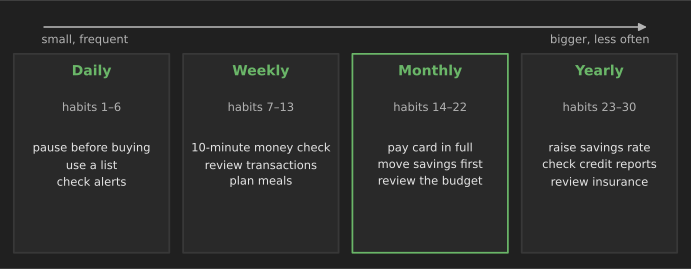
This guide lists 30 smart money habits, grouped by how often you do them: daily, weekly, monthly and yearly. Each habit comes with a concrete way to start. You do not need all 30. Pick three that fix your biggest problem, make them automatic, then add more.
The short answer. The habits that matter most are the boring ones: automate saving on payday (habit 15), pay your card in full every month (habit 14), check your money for ten minutes a week (habit 7), raise your savings rate every year (habit 23) and invest automatically in low-cost funds without reacting to the news (habit 20).
How we wrote this. Where a habit is backed by research, such as studies on automatic enrollment and habit formation, we link to it. Other habits are practical advice, and we say so. This is general education, not personal financial advice.
Why habits beat willpower
Two research findings explain why habits work better than good intentions.
Defaults are powerful. When a large U.S. employer switched its 401(k) plan from opt-in to automatic enrollment, participation rose sharply and many new employees simply kept the default contribution rate and fund (Madrian and Shea, NBER). The pattern still holds: in Vanguard's 2025 data, 94% of eligible employees participated in plans with automatic enrollment, compared with 64% in plans where employees had to sign up themselves (Vanguard, How America Saves 2026). Make the good choice the default and you no longer need to choose it every month.
Habits take time, and missing a day is fine. In a study of 82 people building a new daily habit, Phillippa Lally and colleagues at University College London found it took an average of 66 days for a behavior to feel automatic, with individual times ranging from 18 days to a predicted 254 days. Missing a single day had little effect on progress (BPS Research Digest). The lesson: give a money habit two or three months, and do not quit after one slip.
Daily habits (1–6)
1. Pause before non-essential purchases
Before buying anything you did not plan, wait: a day for small things, a month for large ones. Many wants fade with time, and the ones that remain are probably worth buying. Start: keep a wish list in your phone and add items there instead of buying them.
2. Shop with a list
A list keeps grocery and household shopping to what you need. Start: keep a shared list on your phone and add items when you run out, not when you are in the store.
3. Turn on alerts and glance at them
Transaction and low-balance alerts let you spot fraud, double charges and overspending the day they happen, not at month end. Start: turn on alerts for every card purchase and for any balance below a set amount.
4. Plan your food for the day
Food bought on impulse, such as lunch near work or late-night delivery, adds up quickly. Start: decide each morning where lunch and dinner will come from. Bringing lunch twice a week is a realistic first step.
5. Add friction to spending
Saved cards, one-click checkout and shopping apps make spending effortless. Start: remove saved cards from shopping sites you visit too often, and delete one shopping app from your phone.
6. Stop and verify before sending money
Unexpected requests for money are the most common path to fraud. In 2025, U.S. consumers reported $15.9 billion in fraud losses to the FTC, and impostor scams were the most reported type (FTC, March 2026). Start: make it a rule never to send money, gift cards or crypto in response to a message or call you did not expect; hang up and call back on a number you look up yourself.
Weekly habits (7–13)
7. Hold a 10-minute money check-in
Pick the same time each week, such as Sunday morning. Check account balances, upcoming bills and how much is left in your spending categories. Ten minutes a week stops small problems from becoming big ones. Start: add a recurring 10-minute event to your calendar.
8. Review and categorize your transactions
Scroll through the week's transactions and label anything unclear. Catching an unexpected subscription or a wrong charge early is easier than disputing it months later. Start: do it during your weekly check-in.
9. Plan meals and groceries
Weekly meal planning cuts both waste and takeout. Start: plan four dinners for the week and build the grocery list from them.
10. Look ahead at the next two weeks of bills
Knowing what is due prevents overdrafts and late fees. Start: list each bill's due date in a calendar, and line due dates up with paydays where providers allow it; the CFPB suggests asking creditors to change due dates to help manage cash flow (CFPB).
11. Sweep leftover spending money into savings
If you finish a week under budget, move the difference to savings before it gets spent. Start: at your weekly check-in, transfer whatever is left in your weekly spending amount.
12. Keep one goal visible
A goal you can see, such as "$5,000 emergency fund" with a progress bar, is easier to stick to. Start: name your savings account after the goal and check its progress weekly.
13. Talk about money at home
If you share finances, a short weekly conversation prevents surprises and arguments. Start: five minutes after your own check-in: upcoming costs, progress on one goal, anything that needs a decision.
Monthly habits (14–22)
14. Pay the full statement balance on every card
The average interest rate on U.S. card accounts charged interest was 22.36% in August 2026 (Federal Reserve G.19). Paying the statement balance in full every month avoids interest on most cards and builds payment history, the largest part of a FICO score (myFICO). Start: set autopay for the full statement balance, or at least the minimum plus a manual payment.
15. Pay yourself first on payday
Move money to savings and investments automatically on the day your pay arrives. Start: set up a recurring transfer, or ask your employer to split your direct deposit between two accounts.
16. Compare your budget with what actually happened
Once a month, compare planned and actual spending by category. Adjust categories that are always wrong, rather than feeling guilty about them. Start: use whichever method suits you from our 20 budgeting methods.
17. Fund your sinking funds
Set aside money each month for predictable non-monthly costs: insurance, car maintenance, holidays, gifts. Start: add up next year's irregular costs, divide by 12, and automate that transfer.
18. Make one extra debt payment
Put any extra money toward one target debt, either the highest rate (avalanche) or the smallest balance (snowball). On a $5,000 card balance at 22.36%, raising the payment from $150 to $300 a month cuts total interest from about $2,886 to $1,043 (our calculation). Start: add a second scheduled payment to the target debt each month.
19. Review recurring charges
Subscriptions, memberships and app charges creep up. Start: each month, look at recurring charges and cancel one you no longer use.
20. Invest automatically, and ignore the noise
Invest a fixed amount on a fixed schedule into diversified, low-cost funds, regardless of what markets are doing. This is called dollar-cost averaging. It removes the temptation to time the market, which most professionals fail to do well: in the first half of 2026, 67% of active U.S. large-cap funds trailed the S&P 500 (S&P Dow Jones Indices). Start: schedule an automatic investment for the day after payday, and limit how often you check balances.
21. Update your net worth
Net worth (assets minus debts) shows whether all these habits are working. Start: keep a simple spreadsheet with one row per account and update it on the first weekend of each month, or each quarter if monthly feels like too much.
22. Plan a no-spend day or weekend
A day or weekend with no discretionary spending resets habits and shows which purchases you actually miss. Start: pick one weekend a month and plan free activities in advance.
Yearly habits (23–30)
23. Raise your savings rate
Raise the share of income you save by at least one percentage point each year, or put part of every raise into savings. In the "Save More Tomorrow" program designed by Richard Thaler and Shlomo Benartzi, employees committed in advance to save more from future raises, and participants' average savings rate rose from 3.5% to 13.6% over about 40 months (Thaler and Benartzi, 2004). Start: turn on automatic escalation in your workplace plan if it offers it.
24. Check your credit reports
Look for accounts you do not recognize and errors that could cost you on future loans. In the U.S., free reports from all three bureaus are available weekly at AnnualCreditReport.com (CFPB). Start: check at least once a year, and before any big loan application.
25. Review insurance and shop around
Prices change, and loyalty is not always rewarded. Start: at each renewal, get two or three quotes for car, home or renters insurance, and check that coverage still fits your life.
26. Rebalance your investments
Over time, the mix of stocks, bonds and cash drifts as markets move. Once a year, bring it back to your target mix. Start: pick a date, such as your birthday, and rebalance using new contributions first to limit selling.
27. Use tax-advantaged accounts to the limit you can afford
Contribution limits change each year. In the U.S. for 2026, the limits are $24,500 for 401(k)-type plans and $7,500 for IRAs (IRS), and $4,400 (self-only) or $8,750 (family) for HSAs (IRS Rev. Proc. 2025-19). Start: each January, check the new limits and adjust contributions.
28. Update beneficiaries and key documents
Retirement accounts and life insurance usually pass to the beneficiaries named on the account, not to whoever is named in a will. Start: once a year, and after any marriage, divorce or birth, check beneficiaries and keep a list of accounts somewhere a trusted person can find it.
29. Invest in your earning power
Your income is usually your biggest financial asset early in your career. Start: once a year, research pay for your role, ask for a raise or promotion with evidence of your results, and spend some time or money on a skill that raises your value.
30. Set goals and review the year
Look back at your net worth, savings rate and debt, then set two or three concrete goals for next year. A benchmark helps: Fidelity suggests aiming to have saved about 1x your salary by 30, 3x by 40, 6x by 50, 8x by 60 and 10x by 67 (Fidelity). Start: block one afternoon in December or January for a money review.
How to build these habits
- Start with three. Choose habits that fix your biggest problem. Carrying card debt? Start with 14, 18 and 1. No savings? Start with 15, 7 and 19.
- Automate first. Anything that can be automatic (habits 14, 15, 17, 20, 23) should be. Automation is the most reliable habit there is.
- Attach habits to cues. Do the weekly check-in after Sunday breakfast, the yearly review on your birthday. A fixed cue helps a habit form.
- Give it two months. Habits take weeks to feel automatic. Missing a day is normal; missing many in a row is the warning sign.
- Track progress, not perfection. A rising net worth and savings rate matter more than a perfect budget.
For specific actions to take this year, read our 25 money management tips for 2026. For the rules of thumb that tell you whether you are on track, see 15 personal finance rules. If you are early in your career, 10 money management skills to learn in your 20s explains the foundations. You can also follow independent writers on saving, investing and financial independence in our Personal Finance blog directory.
FAQ
What are the most important money habits?
Spending less than you earn, saving automatically on payday, paying credit cards in full, investing regularly in low-cost diversified funds, and reviewing your finances on a schedule. Most other habits support one of these.
How long does it take to build a money habit?
In one well-known study, new daily habits took an average of 66 days to feel automatic, with wide variation between people. Automating a habit, such as a savings transfer, makes it work from day one.
What does financial freedom mean?
It usually means having enough savings and investments that you could cover your living costs without needing a paycheck, so working becomes a choice. It is reached gradually by saving a meaningful share of income for many years and investing it well.
References
All accessed 25 October 2026.
- Madrian, B. and Shea, D. (2001). The Power of Suggestion: Inertia in 401(k) Participation and Savings Behavior. Quarterly Journal of Economics 116(4).
- Vanguard. How America Saves 2026 (data as of year-end 2025).
- Lally, P. et al. (2010). "How are habits formed: Modelling habit formation in the real world." European Journal of Social Psychology 40(6); summarized by the BPS Research Digest.
- Federal Trade Commission. Testimony before the Joint Economic Committee on the rising scam economy (25 March 2026).
- Consumer Financial Protection Bureau. An essential guide to building an emergency fund; How do I get a free copy of my credit reports?.
- Board of Governors of the Federal Reserve System. G.19 Consumer Credit (7 October 2026).
- myFICO. What's in my FICO Scores?.
- S&P Dow Jones Indices. SPIVA U.S. Mid-Year 2026 Scorecard.
- Thaler, R. and Benartzi, S. (2004). Save More Tomorrow: Using Behavioral Economics to Increase Employee Saving. Journal of Political Economy 112(S1).
- Internal Revenue Service. 401(k) limit increases to $24,500 for 2026, IRA limit increases to $7,500; Revenue Procedure 2025-19.
- Fidelity Investments. How much do I need to retire?.