Your 20s are when money habits set. It is often the first decade of a full paycheck, a lease, a credit card and a retirement plan, and it is also when time does the most work for your savings. Nobody is born knowing how to handle money; these are skills, and like any skill they can be learned and practiced. This guide covers 10 money management skills worth learning in your 20s, what each involves, and a first step you can take this week.
The short answer. Learn to read your paycheck, track and budget your spending, keep an emergency fund, build good credit, handle debt and student loans, use your employer's benefits, start investing early, grow your income, protect yourself from big losses and scams, and plan for big goals without lifestyle creep.
How we wrote this. Facts about U.S. rules, such as account limits, credit scoring and student loan plans, come from government agencies and the organizations that set them, checked on 25 October 2026. Examples are our own calculations with stated assumptions. Rules differ by country; if you live outside the U.S., look for the equivalent accounts and protections where you live. This is general education, not personal financial advice.
Why your 20s matter so much
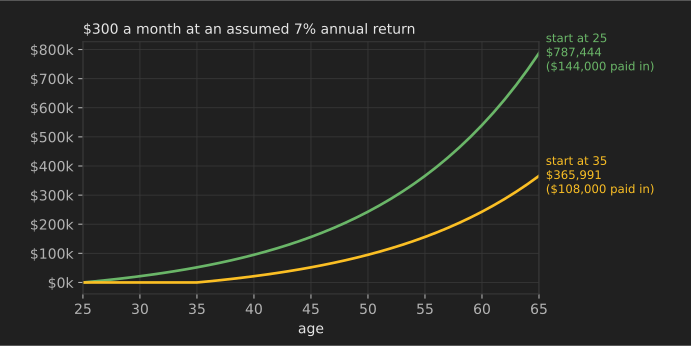
Time multiplies early savings. Suppose you invest $300 a month and earn an average of 7% a year (an assumption for illustration; real returns vary and are not guaranteed). Starting at 25, you would pay in $144,000 by age 65 and end with about $787,000. Starting at 35 with the same amount, you would pay in $108,000 and end with about $366,000 (our calculation, monthly compounding). Ten extra years of contributions add $36,000 of deposits but more than double the result.
Young adults are often the least prepared for shocks. In the Federal Reserve's 2025 survey, 63% of all U.S. adults said they could cover a $400 emergency expense with cash or its equivalent, and the Fed reported meaningful declines in financial well-being among young adults (Federal Reserve, May 2026). Learning the basics early protects you from expensive mistakes that take years to undo.
1. Reading your paycheck
What it is. Understanding the difference between gross pay (what you earn before deductions) and net pay (what reaches your bank account), and what is taken out in between: income taxes, Social Security and Medicare, health insurance premiums, and retirement contributions.
Why it matters. Your budget runs on net pay, but job offers are quoted in gross pay. Many people in their first job are surprised by how big the gap is. Getting tax withholding wrong can also mean a large bill at tax time.
First step. Read your latest pay stub line by line and look up anything you do not recognize. In the U.S., use the IRS Tax Withholding Estimator to check that your W-4 withholding fits your situation, especially after a job change or a second job.
2. Tracking spending and making a budget
What it is. Knowing where your money goes each month and making a plan for it before the month starts.
Why it matters. Without a plan, spending tends to grow to match income, and savings become whatever is left, which is often nothing.
First step. Track every expense for one month, then choose a simple method. The 50/30/20 split (50% needs, 30% wants, 20% savings and debt) or pay yourself first are good starting points. Our guide to 20 budgeting methods compares the options, including ones for irregular income from freelancing or gig work.
3. Building an emergency fund
What it is. Cash set aside only for real surprises: a job loss, a car repair, a medical bill.
Why it matters. Without it, every surprise goes on a credit card. The CFPB suggests basing your goal on the unexpected costs you have actually had, and notes that even a small amount gives some security (CFPB). Fidelity suggests a starter fund of $1,000 or one month of essentials, whichever is more, then building toward three to six months of essential expenses (Fidelity).
First step. Open a separate savings account at an insured bank or credit union and set an automatic transfer on payday, even $25. In the U.S., FDIC insurance covers deposits up to $250,000 per depositor, per insured bank, for each account ownership category (FDIC).
4. Building and protecting your credit
What it is. A credit score summarizes how you have handled borrowing. Landlords, lenders and sometimes insurers use it, and a good score can save you thousands on a car loan or mortgage.
What counts. For FICO scores, the most widely used type, payment history counts for about 35%, amounts owed for 30%, length of credit history for 15%, new credit for 10% and credit mix for 10% (myFICO). myFICO also notes that using a low share of your available credit tends to help your score.
First step.
- Pay every bill on time; set up autopay for at least the minimum.
- If you get a credit card, use it for small regular purchases and pay the full statement balance every month.
- Keep balances low relative to your limits.
- Keep your oldest account open if it has no annual fee, because the length of your history matters.
- Check your credit reports for free; in the U.S., you can get them weekly from each bureau at AnnualCreditReport.com (CFPB).
5. Managing debt, including student loans
What it is. Knowing the interest rate, minimum payment and payoff plan for everything you owe, and knowing which debts to pay first.
Why it matters. High-interest debt grows fast. The average rate on U.S. card accounts charged interest was 22.36% in August 2026 (Federal Reserve G.19). A $5,000 card balance paid at $150 a month at that rate takes 53 months and costs about $2,886 in interest; at $300 a month it takes 21 months and about $1,043 (our calculation).
Student loans changed in 2026. For U.S. federal student loans, new loans made on or after 1 July 2026 have two repayment options: a new tiered standard plan and the income-driven Repayment Assistance Plan (RAP), which forgives remaining balances only after 30 years of qualifying payments. The SAVE plan has ended, and the older PAYE and ICR plans close to existing borrowers on 1 July 2028 (NYC Department of Consumer and Worker Protection). Rules are still being implemented, so check your own options at StudentAid.gov rather than relying on summaries.
First step. List every debt with its balance, rate and minimum. Pay the minimum on all of them, then put extra money toward one debt: the highest rate first (avalanche) saves the most; the smallest balance first (snowball) gives quicker wins.
6. Using your employer's benefits
What it is. Benefits are part of your pay. The big ones are retirement plans with an employer match, health insurance, health savings accounts (HSAs) and sometimes disability or life insurance.
Why it matters.
- The match is free money. With a 50% match on the first 6% of a $50,000 salary, contributing $3,000 a year brings in another $1,500 from your employer.
- Automatic enrollment may not be enough. Many plans enroll you automatically at a low default rate; in Vanguard's plans, the average employee deferral rate was 7.6% in 2025 (Vanguard, How America Saves 2026). Check that your rate captures the full match.
- Limits for 2026: $24,500 for 401(k), 403(b) and most 457 plans, and $7,500 for IRAs (IRS). With a high-deductible health plan, you can put up to $4,400 (self-only) in an HSA (IRS Rev. Proc. 2025-19).
- Health coverage until 26. In the U.S., if a parent's plan covers dependents, you can usually stay on it until age 26, even if you are married or do not live with your parents (HHS). Plan for what happens after.
First step. Read your benefits guide, find the match formula and vesting schedule, and set your contribution to get the full match.
7. Investing early and simply
What it is. Putting long-term money into diversified investments, such as broad stock and bond index funds, and leaving it to grow for decades.
Why it matters. Early money has the most time to compound, as the chart above shows. Keeping costs low matters too: $100,000 growing at 7% for 30 years ends near $750,600 with a 0.05% annual fee but near $574,300 with a 1% fee (our calculation). Low-cost index funds are a sensible default for most beginners; in the first half of 2026, 67% of active U.S. large-cap funds trailed the S&P 500 (S&P Dow Jones Indices).
What to avoid. Money you need within a few years does not belong in stocks. Avoid putting a large share of your savings into a single stock, a friend's tip or a coin you saw on social media.
First step. Choose a low-cost, diversified fund inside your workplace plan or IRA, such as a target-date or broad index fund, and set up automatic monthly contributions. The SEC's Investor.gov explains how to match your mix of investments to your time horizon and risk tolerance.
8. Growing your income
What it is. Negotiating pay, building skills that employers value, and deciding when to change jobs.
Why it matters. In your 20s, your future earnings are usually worth far more than your savings. A higher starting salary also raises future raises, which are often a percentage of current pay, and employer contributions tied to salary.
First step. Before your next offer or review, research pay ranges for your role and location, write down your results with numbers, and ask. Treat one new skill or certification a year as an investment.
9. Protecting yourself from big losses
What it is. Insurance against costs you could not pay yourself, and defenses against fraud.
Insurance basics in your 20s. Health insurance first. Renters insurance is usually cheap and covers your belongings and liability. Disability insurance matters if you depend on your income. Life insurance mainly matters once someone depends on you; for most people that means term life insurance.
Fraud. In 2025, U.S. consumers reported $15.9 billion in fraud losses to the FTC. Investment scams caused the largest losses, at over $7.9 billion, and impostor scams were the most reported (FTC, March 2026). Scams often reach people through messages, social media and dating apps.
First step. Turn on two-factor authentication for your bank, email and investment accounts; set up transaction alerts; and never send money, gift cards or crypto in response to a message you did not expect. Check anyone offering investments using FINRA's free BrokerCheck.
10. Planning big goals without lifestyle creep
What it is. Saving ahead for large purchases, such as a car, a move, a wedding or a home deposit, and keeping your spending from rising every time your income does (lifestyle creep or lifestyle inflation).
Why it matters. Big purchases bought on credit become long-term debt. And if spending rises with every raise, your savings rate never improves. In Richard Thaler and Shlomo Benartzi's "Save More Tomorrow" program, employees who committed in advance to save part of future raises lifted their average savings rate from 3.5% to 13.6% over about 40 months (Thaler and Benartzi, 2004).
First step. For each goal, write down the cost and date, divide by the months remaining, and automate that amount into a labeled savings account. When you get a raise, send at least half of the increase to savings or debt before adjusting your spending.
A plan for your 20s, step by step
- Track one month of spending and read your pay stub (skills 1 and 2).
- Build a starter emergency fund of $1,000 or one month of essentials (skill 3).
- Contribute enough to get the full employer match (skill 6).
- Pay off high-interest debt; set up the right plan for student loans (skill 5).
- Grow the emergency fund to three to six months of essentials (skill 3).
- Raise retirement saving toward 15% of pre-tax income, including the match, in low-cost funds (skill 7).
- Keep building credit, income and protection along the way (skills 4, 8 and 9).
You do not need to do it all at once. For specific actions this year, see our 25 money management tips for 2026; for the routines that keep these skills working, see 30 smart money habits; and for the rules of thumb that tell you whether you are on track, read 15 personal finance rules. To keep learning from independent writers, browse the Personal Finance blogs in our directory.
FAQ
How much should I have saved by 30?
Fidelity's guideline is about one times your annual salary saved for retirement by age 30, assuming you start saving 15% of income at 25 (Fidelity). Many people are behind that at 30; raising your savings rate is the fix.
Should I invest or pay off student loans first in my 20s?
Get any employer match first, since it is an immediate return. Then compare rates: high-interest private loans and credit cards usually come before extra investing; low-rate federal loans can often be paid on schedule while you invest. Check your federal repayment options at StudentAid.gov.
Is it too late to start managing money at 29?
No. Starting at 29 still gives decades of compounding. The best time to start is when you read this; the second best is next payday.
References
All accessed 25 October 2026.
- Board of Governors of the Federal Reserve System. Economic Well-Being of U.S. Households in 2025, press release (13 May 2026); G.19 Consumer Credit (7 October 2026).
- Internal Revenue Service. Tax Withholding Estimator; 401(k) limit increases to $24,500 for 2026, IRA limit increases to $7,500; Revenue Procedure 2025-19.
- Consumer Financial Protection Bureau. An essential guide to building an emergency fund; How do I get a free copy of my credit reports?.
- Fidelity Investments. Fidelity's easy budgeting guideline; How much do I need to retire?.
- Federal Deposit Insurance Corporation. Understanding Deposit Insurance.
- myFICO. What's in my FICO Scores?.
- NYC Department of Consumer and Worker Protection. Key Changes in Federal Student Loan Repayment: Coming July 2026; Federal Student Aid, StudentAid.gov.
- Vanguard. How America Saves 2026.
- U.S. Department of Health and Human Services. Young Adult Coverage.
- S&P Dow Jones Indices. SPIVA U.S. Mid-Year 2026 Scorecard.
- U.S. Securities and Exchange Commission, Investor.gov. Asset Allocation.
- Federal Trade Commission. Testimony before the Joint Economic Committee on the rising scam economy (25 March 2026).
- FINRA. BrokerCheck.
- Thaler, R. and Benartzi, S. (2004). Save More Tomorrow: Using Behavioral Economics to Increase Employee Saving. Journal of Political Economy 112(S1).