Making money from home does not require buying inventory, a franchise or an expensive course. Most of the ways that work start with what you already have: a skill, a computer, a spare room, a kitchen, a car, or stuff you no longer use. This guide lists 30 ways to earn from home, grouped by how much you need to spend before the first dollar comes in, from about $0 to around $100, plus the local rules that catch people out.
The short answer. Start with something that costs nothing: freelancing a skill, tutoring, selling what you own, or caring for pets or children in your home where it is allowed. Spend money only once you have a paying customer, and never pay someone for the right to work.
How we wrote this. Platform rules and fees were checked on official pages, and tax and consumer-protection facts on IRS and FTC pages, on 25 October 2026. Startup costs are our rough estimates of the minimum to begin; they are not quotes. Rules for home businesses, food sales and childcare differ widely between countries, U.S. states and cities, so we flag where to check rather than state rules that may not apply to you. This is general education, not financial, tax or legal advice.
Three questions before you choose
- What can I start this week with what I own? That is your list of $0 ideas.
- What does my lease, homeowners' association or local zoning allow? Customers visiting your home, pets, childcare, food production and signs are the usual restrictions.
- Will I report it properly? In the U.S., net self-employment earnings of $400 or more in a year are subject to self-employment tax (IRS), and income is reportable whether or not a platform sends you a form (IRS).
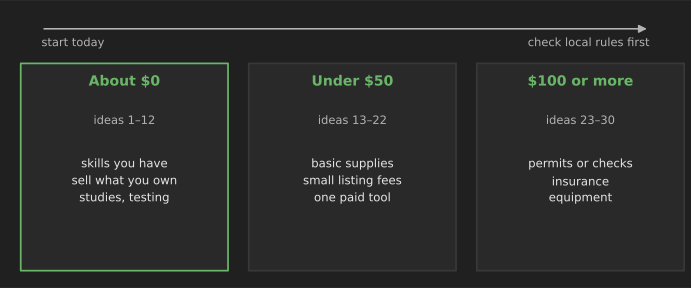
About $0 to start (ideas 1–12)
You need a computer or phone, an internet connection and time.
1. Freelance writing or editing
Write or edit blog posts, newsletters, product descriptions and reports for businesses. A focused niche and two or three strong samples help you stand out. See our guide to making money online for how marketplaces and direct pitching compare.
2. Virtual assistant services
Manage inboxes, calendars, travel, research and customer messages for busy people. Organization and reliability matter more than credentials.
3. Online tutoring
Teach school subjects, languages, music or test prep by video. Start with students you can reach through friends, schools and local groups, or join a platform that finds students for you in exchange for a share.
4. Customer support from home
Some companies hire remote support agents as employees or contractors. Look for listings on the company's own careers page. Legitimate employers do not charge you for training, equipment or a "starter kit"; the FTC warns that requests like these are signs of a job scam (FTC).
5. Social media management
Plan, write and schedule posts for small businesses that know they should post but never do. Offer a simple fixed monthly package.
6. Data entry and spreadsheet cleanup
Small businesses often have messy customer lists, inventories and records. If you are good with spreadsheets, cleaning and organizing data is valuable, approachable work. Our pandas tips are useful if you want to automate it.
7. Selling things you no longer use
Clothes, electronics, furniture, books, toys and sports gear sell well on online marketplaces. It is the fastest way to turn your home into cash. Photograph in daylight, describe flaws honestly and price from completed sales, not asking prices.
8. Paid research studies
Academic and market researchers pay participants for online studies. Prolific, for example, requires researchers to pay at least £6 or $8 per hour (Prolific). Availability varies, so treat this as a small top-up.
9. Usability testing
Testing platforms pay you to try websites and apps while thinking aloud. You need a quiet room and a working microphone.
10. AI training and rating tasks
Rate chatbot answers, label data or write example responses for AI training projects. Specialist knowledge (coding, math, medicine, a second language) pays more. Never deposit money to "unlock" tasks; that is a common scam pattern (FTC).
11. Translation and post-editing
If you are fluent in two languages, translate or correct machine translations for businesses and individuals.
12. Consulting calls in your field
People with professional experience can sell one-off advice calls: career reviews, résumé feedback, small-business marketing, software setup. Start with people in your network.
Under $50 to start (ideas 13–22)
A few supplies, small listing fees or one tool subscription.
13. Digital downloads
Sell templates, planners, spreadsheets or printables. Gumroad charges 10% + $0.50 per sale through your own link and 30% through its marketplace (Gumroad).
14. Print-on-demand designs
Upload original designs; the printer produces and ships each order. Your costs are mainly time and perhaps a design tool. Avoid copyrighted characters, logos and lyrics.
15. Handmade crafts
Jewelry, candles, prints, knitwear and custom gifts sell online and at local markets. Start with materials for a small batch and raise prices once you know your real time per piece. Some products, such as candles, cosmetics and children's items, have safety or labeling rules; check them for your market before selling.
16. Self-published e-books
Publishing on Amazon KDP is free; e-book royalties are 35% or 70% depending on the option and market (Amazon KDP). Budget for a professional cover if you can. Disclose AI-generated text or images as KDP requires (KDP).
17. A newsletter
Start free and add paid subscriptions later. Substack takes 10% of paid subscriptions, plus Stripe processing (Substack).
18. Video editing
Edit long-form videos or cut them into short clips with captions for creators and businesses. A free editor is enough to start; a paid plan comes later.
19. Graphic design
Make logos, social graphics and presentations for small businesses. A design tool's paid tier is often the only cost.
20. Flipping thrift finds
Buy underpriced items at garage sales and thrift stores, clean them up and resell. Start with a small budget in one category you understand.
21. Sewing alterations and repairs
Hemming, mending and simple alterations are in steady local demand. A basic sewing machine you already own, or a modest secondhand one, is enough to start.
22. Plant propagation
Cuttings from houseplants and garden plants can be rooted and sold locally. Check whether your area requires a nursery license for regular plant sales.
Around $100 or more to start (ideas 23–30)
These usually need equipment, insurance, permits or background checks. Check local rules first.
23. Pet sitting and boarding at home
Overnight boarding, daycare and drop-in visits are booked through apps or word of mouth. Platforms take a service fee; Rover's UK help page, for example, says sitters keep 85% of each booking, with rates varying by country (Rover). Leases and local rules may limit animals in your home.
24. Childcare in your home
Babysitting occasional evenings rarely needs a license, but caring regularly for other people's children in your home usually does, with rules on numbers, space and safety that vary by state and country. Contact your local licensing agency before you start; a first-aid and CPR course is a sensible first expense.
25. Home baking and cottage food
Many U.S. states allow certain low-risk foods made in a home kitchen to be sold directly to customers under "cottage food" laws, with limits on which foods, where you can sell and how much. Some require permits, labels or training. Look up your state's rules before your first sale.
26. Photography
Portraits, product photos for small businesses and real-estate photos can be shot and edited from a home base. A capable camera you already own keeps costs down.
27. Music, art or language lessons at home
If you play an instrument, paint or speak another language, teach in person at home or online. Check zoning rules if students visit regularly.
28. Renting out a room or storage space
Renting a spare room, garage or driveway uses space you already pay for. Leases, homeowners' associations, mortgages and short-term rental rules can restrict it, and you should check your insurance.
29. Bookkeeping
Monthly bookkeeping for small businesses can be done entirely from home on your own schedule. A course or software certification (often the main cost) builds trust.
30. Small-batch reselling
Buy discounted or clearance goods in small quantities and resell them online. Check whether the brand restricts resale on your marketplace, keep receipts, and start with a budget you can afford to lose.
Scams that target people looking for home-based work
- Pay-to-work offers. Starter kits, training fees, certification fees and paid job lists. The FTC says honest employers never charge you to get a job (FTC).
- Reshipping "jobs". Receiving packages, repackaging them and sending them on. The FTC says reshipping goods is never a real job; it is often part of a fraud scheme (FTC).
- Fake checks. Being sent a check and asked to send part of it back or buy gift cards. The check will bounce and you will owe the bank (FTC).
- Recruitment schemes. The FTC notes most people in legitimate multi-level marketing companies make little or no money, and some lose money; if income depends mainly on recruiting, it may be an illegal pyramid scheme (FTC).
Report job scams at ReportFraud.ftc.gov in the U.S.
Keep more of what you earn
- Separate the money. A dedicated account makes it easy to see profit and set aside taxes; 25–30% of profit is a cautious starting point until you know your real rate.
- Track expenses. Supplies, platform fees and a share of internet or phone costs used for the business may be deductible. Home-office rules are specific, so check IRS guidance or a tax professional.
- Put income to work. Decide in advance where side income goes: an emergency fund, debt payoff or investing. Our 20 budgeting methods can help.
FAQ
How can I make money from home with no money?
Use what you already have: sell items you no longer need, freelance a skill, tutor, or take paid studies and usability tests. All of these can start with a phone or computer and no upfront spending.
What home-based work is legitimate?
Work where a real customer pays for a real product or service: freelancing, tutoring, selling goods, caring for pets or children with any required license, and employee jobs listed on a company's own website. Be wary of anything that requires payment to start or promises high pay for little work.
Do I need a license to sell food or run a business from home?
Often, yes, depending on what you do and where you live. Food sales, childcare, hair and beauty services, and businesses with customer visits are commonly regulated. Check with your city or county and your state's licensing agencies.
How much can I earn from home?
It varies too much to give a reliable figure. Freelancing and tutoring are paid per project or hour and can grow with skill; reselling and crafts depend on margins and volume; studies and testing pay small amounts.
Related reading
- 25 ways to make money online in 2026 for beginners
- 15 side hustle ideas to earn extra money after work
- 20 passive income ideas to build long-term wealth
- 10 AI tools to make money online in 2026
References
All accessed 25 October 2026.
- Internal Revenue Service. Self-Employment Tax (Social Security and Medicare Taxes); IRS issues FAQs on Form 1099-K threshold under the One, Big, Beautiful Bill (23 October 2025).
- Federal Trade Commission. Job Scams; Multi-Level Marketing Businesses and Pyramid Schemes.
- Prolific. How much should I pay participants?.
- Gumroad. Pricing.
- Amazon Kindle Direct Publishing. eBook Royalties; Content Guidelines.
- Substack. How much does Substack cost? (updated 29 September 2026).
- Rover. UK Help Centre: sitter earnings and service fees.