Passive income is money that keeps arriving without you trading an hour of work for each dollar: interest, dividends, rent, royalties, or sales of something you made once. It is real, but it is rarely passive at the start. Every source needs either capital (money you have already saved) or upfront work (something you build), and usually some ongoing upkeep. This guide sorts 20 passive income ideas into those two groups and shows what each one really asks of you.
The short answer. The most reliable long-term passive income for most people comes from investing steadily in low-cost, diversified funds and letting returns compound for decades. Interest-paying accounts and Treasuries are safer but grow slowly. Rental property and creative assets can pay more but take real work. Anything promising high, guaranteed, effortless returns is almost certainly a scam.
How we wrote this. Interest rates, limits and rules come from the FDIC, TreasuryDirect, the SEC and the IRS, checked on 25 October 2026. The capital calculations are our own arithmetic using those published rates. U.S. accounts and tax rules are used as examples; other countries have equivalents. This article is general education, not personalized investment advice; we are not licensed advisers, and you should consider a fee-only fiduciary for decisions about your own money.
How much money does "passive" really take?
The most useful number in passive income is how much capital a target income needs. To produce $500 a month ($6,000 a year):
| Yield | Example | Money needed |
|---|---|---|
| 0.38% | U.S. national average savings rate, October 2026 (FDIC) | $1,578,947 |
| 1.76% | National average 12-month CD (FDIC) | $340,909 |
| 4.00% | The "4% rule" of thumb for portfolio withdrawals | $150,000 |
| 4.26% | I bonds bought May–October 2026 (TreasuryDirect) | $140,845 |
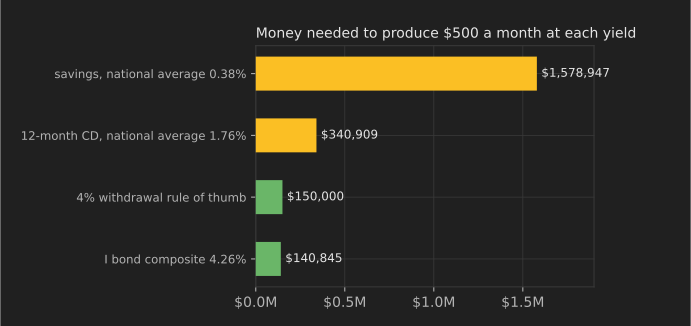
Two lessons follow. First, where you keep cash matters: the gap between the average savings rate and better accounts is large. Second, meaningful investment income needs meaningful capital, which is why the real work of passive income is usually saving and investing consistently for years. Our article on 15 personal finance rules explains the 4% rule and when it breaks.
Part 1: Let your money earn (ideas 1–13)
These need capital but little ongoing effort. Risk rises roughly as you go down the list.
1. High-yield savings account
The simplest passive income: interest on cash you keep anyway, such as your emergency fund. The FDIC's national average savings rate was 0.38% in October 2026, while many online banks pay several times that (FDIC). Deposits at FDIC-insured banks are protected up to $250,000 per depositor, per bank, per ownership category (FDIC). Rates are variable and fall when central bank rates fall.
2. Certificates of deposit and CD ladders
A CD locks your money for a fixed term at a fixed rate; withdrawing early usually costs a penalty. A ladder (for example, five CDs maturing one year apart) gives you a fixed rate on part of your cash while some matures every year. The national average 12-month CD paid 1.76% in October 2026, so shop around (FDIC).
3. Treasury bills, notes and bonds
U.S. Treasury securities are backed by the federal government and their interest is exempt from state and local income tax. Bills mature in a year or less; notes and bonds run longer. You can buy them directly at TreasuryDirect or through a brokerage. If you sell before maturity, the price can be higher or lower than you paid.
4. Series I savings bonds
I bonds pay a fixed rate plus an inflation rate that resets every six months. Bonds bought from May to October 2026 earn a composite 4.26% for their first six months (0.90% fixed plus inflation) (TreasuryDirect); the next rate is announced on 1 November. You can buy up to $10,000 in electronic I bonds per Social Security number per calendar year, cannot cash them for 12 months, and lose the last 3 months of interest if you cash them before 5 years (TreasuryDirect).
5. Money market funds
Money market funds hold short-term debt and pay interest that tracks short-term rates. They are available at most brokerages and are commonly used for cash waiting to be invested. Unlike bank deposits, they are not FDIC-insured (FDIC), though they invest conservatively.
6. Bond index funds
A bond fund holds hundreds or thousands of bonds and pays out their interest. Prices fall when interest rates rise and rise when rates fall, so the value is not fixed. Low-cost index funds spread the risk widely. Bonds are often used to steady a stock portfolio rather than as a growth engine.
7. Broad stock index funds
For long-term wealth, this is the core idea for most people. A total-market or S&P 500 index fund owns hundreds of companies and pays their dividends, while the value of the fund can grow with the companies over decades. Over the first half of 2026, 67% of actively managed U.S. large-cap funds trailed the S&P 500, according to S&P Dow Jones Indices (S&P Global), which is why low-cost index funds are a common choice. Stocks can fall sharply in any given year; this is money for goals at least five to ten years away.
8. Dividend-focused funds
Dividend funds hold companies that pay higher or steadily growing dividends. They suit people who want cash payouts, but a high dividend is not the same as a high total return, and companies can cut dividends. Broad diversification and low fees matter more than chasing the highest yield.
9. Real estate investment trusts (REITs)
REITs own income-producing property such as apartments, warehouses and offices. They must distribute at least 90% of their taxable income to shareholders each year, which is why they tend to pay large dividends (Investor.gov). Publicly traded REITs and REIT index funds can be bought and sold like stocks. Non-traded REITs generally cannot be sold readily on the open market, and their redemption programs are typically limited, so the SEC urges caution (SEC).
10. Tax-advantaged retirement accounts
Not an income source on its own, but the wrapper that makes the others work harder. Employer matches, tax deductions and tax-free growth in 401(k)s, IRAs and HSAs can add more to your wealth than picking the right investment. Our article on 25 money management tips lists the 2026 U.S. contribution limits.
11. Rental property
Rent from a property can cover a mortgage and produce income, and the property may appreciate. But landlords handle vacancies, repairs, tenant problems, insurance, taxes and financing risk, so it is better described as a part-time business unless you pay a property manager (often a share of the rent). For U.S. tax purposes, rental activities are generally treated as passive activities, which limits how losses can be used (IRS). Run the numbers with realistic vacancy and maintenance costs before buying.
12. Renting out a room or part of your home
Renting a spare room, basement suite or accessory dwelling uses an asset you already have. It is less passive (you share your home) and may be restricted by your lease, homeowners' association, mortgage or local short-term rental rules. Check insurance and local permits first.
13. Renting out things you own
Parking spaces, storage space, cameras, tools, trailers and even cars can be rented through peer-to-peer platforms. Income depends heavily on your location and demand. Read the platform's insurance terms closely, because damage and liability are the main risks.
Part 2: Build something once, earn from it later (ideas 14–20)
These need little money but substantial upfront work, and most need ongoing marketing and updates. Most attempts earn little; a minority keep earning for years.
14. Digital products
Templates, spreadsheets, planners, design assets and guides can be sold repeatedly with no inventory. Platforms take a cut; Gumroad, for example, charges 10% + $0.50 per sale through your own link (Gumroad). The product is the easy part; steady traffic is the hard part.
15. Online courses
A recorded course turns your expertise into a product. Courses need updating as tools and facts change, and they sell best when you already have an audience that trusts you. Test demand with a live workshop before recording.
16. Books and royalties
E-books and print books can earn royalties for years. Amazon KDP pays a 35% or 70% royalty on e-book sales depending on the option and the market (Amazon KDP). Most self-published books sell modestly; a series in a popular genre or a practical book on a specific problem gives better odds.
17. Stock photos, video and music licensing
Contributors upload photos, footage, illustrations or music to licensing marketplaces and earn a share of each license. The libraries are huge and earnings per item are usually small, so this works best with large, well-tagged portfolios of specific subjects that buyers search for.
18. A content website
A site that answers specific questions well can earn from ads and affiliate links long after a post is written. It takes many months to build search traffic, and income can drop with search-engine changes. In the U.S., affiliate relationships must be disclosed clearly (FTC).
19. A YouTube library
Older videos can keep earning ad revenue if people keep searching for them. Joining the YouTube Partner Program currently needs 1,000 subscribers plus 4,000 watch hours in 12 months or 10 million Shorts views in 90 days, and the bar for new applicants rises to 8,000 watch hours or 20 million Shorts views from 1 February 2027 (YouTube Help). Evergreen tutorials age better than trend-based videos.
20. Small software products
Plugins, browser extensions, spreadsheet tools and small subscription apps can earn recurring revenue. They also need customer support, bug fixes and security updates, so they are among the least passive ideas here. Good for developers who want a side project with upside; see our Python automation scripts for small-tool ideas.
What to be wary of
- Guaranteed high returns. The SEC lists promises of "guaranteed" returns among the red flags of investment fraud on social media (Investor.gov). Investment scams accounted for over $7.9 billion of reported U.S. fraud losses in 2025 (FTC).
- "Done-for-you" passive businesses. Turnkey vending routes, ATM networks, e-commerce stores and "automation" packages often make more money for the seller than the buyer. Ask for verifiable results from independent owners, not testimonials.
- Courses about passive income. If someone's main income is teaching passive income, their results tell you little about yours.
- High-yield products you cannot explain. If you cannot say where the yield comes from and what happens if things go wrong, do not invest.
A realistic path
- Build an emergency fund in an insured high-yield account (idea 1).
- Collect any employer retirement match and invest regularly in low-cost index funds (ideas 7 and 10).
- Raise your savings rate whenever your income rises.
- Add one "build once" project (ideas 14–20) only if you enjoy the work, and treat early income as a bonus.
- Consider real estate (ideas 11–12) once you have savings, stable income and time to manage it.
For the routines that keep this on track, see 30 smart money habits.
FAQ
What is the easiest passive income for beginners?
Interest on savings and regular investing in a broad index fund. Both can be set up in an afternoon and automated. They grow slowly at first, which is why starting early matters.
How much money do I need to make $1,000 a month in passive income?
At a 4% yield or withdrawal rate, about $300,000 ($12,000 a year ÷ 0.04). At lower yields it takes more. Building that much usually takes years of consistent saving and investing.
Is passive income taxed?
Yes, in most countries. In the U.S., interest and most rental and royalty income are taxed as ordinary income, qualified dividends and long-term capital gains get lower rates, and retirement accounts change when tax is due. Treasury interest is exempt from state and local tax.
Is real estate really passive income?
Rarely at first. Owning rental property involves finding tenants, repairs and finances. A property manager makes it closer to passive at the cost of part of the rent; REITs are the most passive way to own real estate.
Related reading
- 25 ways to make money online in 2026 for beginners
- 15 side hustle ideas to earn extra money after work
- 30 ways to make money from home without investing much
- 10 money management skills to learn in your 20s
- Personal Finance blogs in our directory
References
All accessed 25 October 2026.
- Federal Deposit Insurance Corporation. National Rates and Rate Caps (October 2026 update); Understanding Deposit Insurance.
- U.S. Department of the Treasury, TreasuryDirect. Savings bond rates announced 1 May 2026; I bonds.
- S&P Dow Jones Indices. SPIVA U.S. Mid-Year 2026 Scorecard.
- U.S. Securities and Exchange Commission. Investor Bulletin: Publicly Traded REITs; Investor Bulletin: Real Estate Investment Trusts (REITs); Investor Alert: Social Media and Investing, Avoiding Fraud.
- Internal Revenue Service. Topic no. 425, Passive activities: losses and credits.
- Federal Trade Commission. Testimony before the Joint Economic Committee on the rising scam economy (25 March 2026); Disclosures 101 for Social Media Influencers.
- Gumroad. Pricing.
- Amazon Kindle Direct Publishing. eBook Royalties.
- YouTube Help. Changes to the YouTube Partner Program.