You can make money online in 2026 without a degree or a big budget, but almost every legitimate route works the same way: you sell a skill, your time, a product or an audience's attention, and a platform usually takes a cut. This guide lists 25 ways that beginners actually use, with what each costs to start, how soon the first payment tends to arrive, and what to watch out for.
The short answer. If you need money soon, sell a skill you already have as a freelancer, or pick up paid research studies and usability tests. If you can wait, build something that grows: a channel, a newsletter, a shop or a digital product. Avoid anything that asks you to pay before you can earn.
How we wrote this. Platform rules, fees and thresholds were checked on the platforms' own help and pricing pages on 25 October 2026, and tax rules on IRS pages; where we could only find third-party reporting, we say so. We have not tested these platforms ourselves, and no figure here is an earnings promise: what people earn varies enormously with skill, time, market and luck. Tax details are U.S.-specific. This article is general education, not financial, tax or legal advice.
Before you start: three things that matter more than the idea
1. Scams target people looking for online income. U.S. consumers reported $15.9 billion in fraud losses to the Federal Trade Commission in 2025, from 3 million reports (FTC testimony, March 2026). Job scams are a growing share: reported losses to job and employment agency scams rose from $90 million in 2020 to $501 million in 2024 (FTC, March 2025). The FTC's rule of thumb is simple: honest employers never charge you to get a job, and offers of big pay for little work are a red flag (FTC).
2. Online income is taxable from the first dollar. In the U.S., if your net earnings from self-employment are $400 or more in a year, you owe self-employment tax of 15.3% (12.4% Social Security plus 2.9% Medicare) on top of income tax (IRS). Payment apps and marketplaces only have to send a Form 1099-K once your payments exceed $20,000 and 200 transactions, but the IRS is explicit that you must report all income whether or not you get a form (IRS, October 2025). A simple habit: move 25–30% of every payment into a separate savings account until you know your real tax bill.
3. Platform fees change what you keep. A $100 sale is rarely $100 in your pocket. Each section below names the fee where the platform publishes it.
All 25 at a glance
| # | Way | Startup cost | Skill needed | Typical time to first payment |
|---|---|---|---|---|
| 1 | Freelance writing and editing | $0 | Medium | Days to weeks |
| 2 | Virtual assistant work | $0 | Low–medium | Days to weeks |
| 3 | Graphic design | $0–$20/mo | Medium–high | Weeks |
| 4 | Websites for small businesses | $0–$30/mo | Medium–high | Weeks |
| 5 | Bookkeeping | $0–$50 | Medium–high | Weeks |
| 6 | Translation | $0 | High (fluency) | Days to weeks |
| 7 | Online tutoring | $0 | Medium | Days |
| 8 | Social media management | $0 | Medium | Weeks |
| 9 | Video editing | $0–$20/mo | Medium | Weeks |
| 10 | Captioning and transcription review | $0 | Low–medium | Days |
| 11 | Paid research studies | $0 | None | Days |
| 12 | Website and app usability testing | $0 | Low | Days to weeks |
| 13 | AI training and data annotation | $0 | Low–high | Weeks |
| 14 | Reselling secondhand items | $0 | Low | Days |
| 15 | Print-on-demand | $0 | Low–medium | Weeks to months |
| 16 | Digital downloads | $0 | Medium | Weeks to months |
| 17 | Handmade goods online | Materials | Medium | Weeks |
| 18 | Self-publishing books | $0 | Medium | Months |
| 19 | YouTube | $0 | Medium | Months to years |
| 20 | Blogging | $5–$20/mo | Medium | Months to years |
| 21 | Affiliate marketing | $0 | Medium | Months |
| 22 | Paid newsletter | $0 | Medium | Months |
| 23 | Memberships | $0 | Medium | Months |
| 24 | Online courses and workshops | $0–$50/mo | High | Months |
| 25 | Paid calls and consulting | $0 | High | Weeks |
"Time to first payment" is our qualitative estimate from how each platform pays and how long it usually takes to land work or build an audience, not measured data.
Sell a skill: freelancing (ways 1–10)
Freelancing is the fastest legitimate way for most people to earn online, because the client pays for work you can already do. Marketplaces such as Upwork and Fiverr bring clients to you in exchange for a service fee on your earnings; Upwork shows the freelancer fee for each contract before you submit a proposal (Upwork Help). Finding clients directly, through your network, LinkedIn or local businesses, avoids the fee but takes more selling.
Beginner tip that applies to all ten: build two or three portfolio samples before you pitch. A real piece of work, even unpaid practice for a local charity or a mock project, beats any description of your skills.
1. Freelance writing and editing
Businesses need blog posts, product descriptions, emails and website copy, and many need editing more than writing. Start with a niche you know (your industry, a hobby, a technical field), because specialist writers compete less on price. AI drafting tools have made generic copy cheap, so the paid work is shifting toward subject expertise, original reporting, editing and accuracy checks.
2. Virtual assistant work
Virtual assistants handle email, calendars, research, data entry, customer messages and simple bookkeeping for busy owners. It needs organization and reliability more than a specialist skill, which makes it one of the most beginner-friendly options. Many VAs work evenings for clients in other time zones.
3. Graphic design
Logos, social media graphics, presentations and simple brand kits are in steady demand from small businesses. Free tiers of design tools are enough to start; a paid plan becomes worth it once clients arrive. Show a portfolio of three to five finished pieces in one style rather than many unrelated ones.
4. Websites for small businesses
Many local businesses still have no site or an outdated one. With a no-code builder you can set up a clean site with a menu, booking form and map in a few days, then charge for setup and a monthly maintenance fee. If you can code, our Python projects for beginners are a way to practice.
5. Bookkeeping
Small businesses pay for monthly bookkeeping: categorizing transactions, reconciling accounts and preparing reports for their accountant. It requires care and some accounting knowledge, and a bookkeeping course or software certification helps you get trusted. Avoid giving tax advice unless you are qualified to do so.
6. Translation
Fluency in two languages is a real, scarce skill. Machine translation now produces first drafts, so much of the paid work is post-editing (fixing machine output), plus legal, medical and marketing translation where accuracy and tone matter. Certified translations may require credentials in your country.
7. Online tutoring
School subjects, test preparation, languages, music and coding can all be taught over video. You can join a tutoring platform, which supplies students and takes a cut, or find students through local parent groups and charge directly. Tutoring pays quickly because sessions are paid per hour.
8. Social media management
Small businesses know they should post consistently but rarely have time. A social media manager plans content, writes captions, schedules posts and answers comments. Start by offering a fixed monthly package to one or two local businesses, and report simple results (posts published, followers, messages received) every month.
9. Video editing
Creators, coaches and businesses publish more video than ever and many outsource the editing. Free editors are enough to learn on. Short-form vertical edits (cutting long videos into clips with captions) are a common entry point.
10. Captioning and transcription review
Automatic speech recognition now handles most routine transcription, so the human work that remains is concentrated in checking and correcting machine output, difficult audio, and accuracy-critical captions and transcripts. Expect lower rates than skilled freelancing, but a low barrier to entry and flexible hours.
Trade time for small payments (ways 11–13)
These need no special skill and pay quickly, but earnings are modest and work availability is uneven. They suit filling spare minutes rather than replacing a paycheck.
11. Paid research studies
Universities and companies pay people to take part in online surveys and experiments. Prolific, a widely used research platform, requires researchers to pay at least £6 or $8 per hour and recommends at least £9 or $12, calculated on how long participants actually take (Prolific). Studies appear irregularly, so treat it as pocket money.
12. Website and app usability testing
Testing platforms pay you to use a website or app while thinking aloud on a recording, so designers can see where people get stuck. You need a quiet room, a microphone and the ability to explain what you are doing clearly. Tests are often short and screened for specific demographics.
13. AI training and data annotation
AI companies hire people to label data, rate chatbot answers and write example responses. Generalist tasks need little more than careful reading; specialist projects in coding, math, medicine or law pay more and test your knowledge first. This field also attracts fake "task" jobs that ask you to deposit money or crypto to unlock earnings. That is a scam every time: the FTC's guidance is that you should never pay to get paid (FTC).
Sell things (ways 14–18)
14. Reselling secondhand items
Start with what you already own: clothes, electronics, books, furniture and kids' gear sell well on eBay, Facebook Marketplace, Poshmark, Vinted and local apps. Once you know what sells, some resellers source from thrift stores and garage sales. Photograph items in daylight, list measurements and flaws honestly, and research sold prices, not asking prices. Selling personal items for less than you paid generally is not taxable profit, but reselling for profit is.
15. Print-on-demand
You upload designs; a print-on-demand service prints them on T-shirts, mugs or posters only when someone orders and ships directly to the customer. There is no inventory, but margins are thin and marketplaces are crowded. Original designs for a specific community (a profession, a hobby, a local team) do better than generic slogans. Never use logos, characters or song lyrics you do not have rights to.
16. Digital downloads
Templates, planners, spreadsheets, presets, printables and guides are created once and sold repeatedly. On Gumroad, for example, the fee is 10% + $0.50 per sale through your own link and 30% when a new customer finds you through its Discover marketplace (Gumroad). A $20 template sold through your own link leaves you $17.50 before tax. The hard part is not the file; it is getting people to see it.
17. Handmade goods online
Crafts, jewelry, art and custom gifts sell on Etsy and similar marketplaces, which charge listing, transaction and payment-processing fees; check the current fee schedule on the marketplace before pricing, and include materials, packaging, shipping and your time in the price. Handmade work scales slowly because it is limited by your hours.
18. Self-publishing books
Amazon Kindle Direct Publishing lets you publish e-books and print books for free. For e-books it offers a 35% royalty or a 70% royalty (minus a small delivery cost) on eligible sales (Amazon KDP). KDP requires you to tell it when text, images or translations are AI-generated, even if you edited them afterward (KDP content guidelines). Nonfiction that solves a specific problem and series fiction in popular genres are the most common paths; most books sell few copies, so treat the first as practice.
Build an audience (ways 19–25)
Audience businesses start slowly, often earning nothing for months, but they are the routes where income can keep growing without adding hours one-for-one. Plan to publish consistently for at least six months before judging results.
19. YouTube
To share ad revenue through the YouTube Partner Program today, a channel needs 1,000 subscribers plus either 4,000 public watch hours in the past 12 months or 10 million Shorts views in the past 90 days (YouTube Help). From 1 February 2027, new applicants will need 1,000 subscribers plus 8,000 watch hours or 20 million Shorts views, and earning from the Shorts revenue pool will require 10 million qualified Shorts views in the prior 90 days; fan funding and shopping features keep the lower 500-subscriber entry tier (YouTube Help). Many creators earn first from sponsorships and affiliate links rather than ads.
20. Blogging
A blog earns through display ads, affiliate links, sponsorships and your own products. It takes months for search engines to send meaningful traffic, and search results now include AI-generated answers, so the posts that keep earning are the ones with first-hand experience, original data or tools that a summary cannot replace. Budget for a domain and hosting.
21. Affiliate marketing
You earn a commission when someone buys through your link. Commission rates vary widely by program and change over time, so check the current rate before you build content around a product. In the U.S., the FTC expects you to disclose any financial relationship clearly, next to the recommendation, and in videos within the video itself, not only in the description (FTC). Recommend only what you would recommend without the commission.
22. Paid newsletter
Writers with expertise or a strong point of view can charge subscribers directly. Publishing on Substack is free; if you turn on paid subscriptions, Substack keeps 10% and Stripe charges card processing (2.9% + $0.30 for U.S. cards) plus a 0.7% recurring-billing fee (Substack). Most writers build a free list first and add a paid tier once readers ask for more.
23. Memberships
Memberships let fans support your work monthly in exchange for extras: early access, bonus content, a community. Patreon charges a 10% platform fee for creators who published their page after 4 August 2025, plus payment processing (Patreon). Memberships work best once you already have an audience on another platform.
24. Online courses and workshops
If you can teach a skill step by step, a course or a live cohort can sell for far more than an e-book. Marketplaces bring students but control pricing and take a large share; your own platform lets you keep more but you must bring buyers. Live workshops are a good first test, because you learn what students actually struggle with before recording anything.
25. Paid calls and consulting
Professionals with a few years of experience (in software, marketing, HR, design, finance and many other fields) can sell one-off advice calls or small consulting projects. This is often the highest-paid option per hour on this list, but it depends on real expertise and trust. Start with people who already know your work.
A simple first-30-days plan
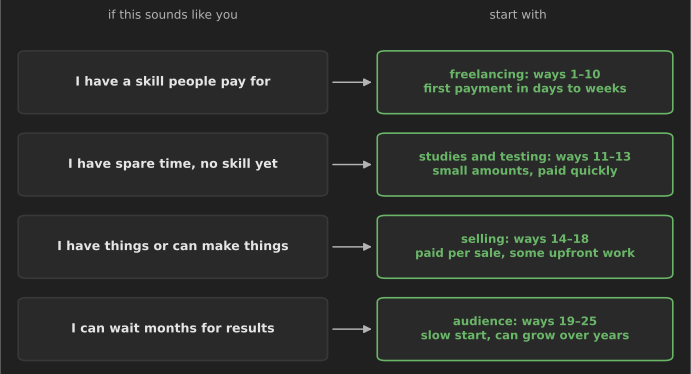
- Days 1–3: pick one way from this list based on the chart above. Not three; one.
- Days 4–10: build the minimum to be taken seriously: two or three portfolio samples, a short profile, or your first five listings.
- Days 11–25: pitch, apply or publish every day. For freelancing, that might be five tailored proposals a day; for selling, five new listings.
- Days 26–30: review what got responses, adjust your offer and price, and open a separate account for tax savings.
Once money starts coming in, give it a job. Our guides to 20 budgeting methods and 25 money management tips cover what to do with it.
Red flags and common mistakes
- Paying to start. "Starter kits", training fees, "activation" deposits and paid job directories are the most common way people lose money looking for online work (FTC).
- Income screenshots as proof. Course sellers who show huge earnings are often earning from selling the course. Judge an opportunity by who pays and for what.
- Recruitment-based schemes. The FTC notes that most people who join legitimate multi-level marketing companies make little or no money, and some lose money (FTC).
- Spreading yourself across five ideas. Each one starts slowly; splitting your time makes all of them slower.
- Ignoring taxes until April. Self-employment tax surprises many first-year earners.
- Breaking platform rules. Fake reviews, undisclosed affiliate links, copied content and unlabeled AI content can get accounts closed and earnings withheld.
FAQ
How much can a beginner make online?
There is no honest single number. Freelancers who already have a marketable skill can earn their first few hundred dollars within weeks; studies and testing usually bring in small amounts; audience businesses often earn little in the first six months and then vary from nothing to a full income. Anyone who promises a specific figure is selling something.
What is the fastest way to make money online?
For most people, freelancing a skill you already have, online tutoring, or selling items you already own. Each pays as soon as the work or sale is done, rather than after an audience builds up.
Can I make money online without spending anything?
Yes. Freelancing, tutoring, research studies, testing and selling your own items can all start at $0 with a computer and an internet connection. If a "free opportunity" asks for payment to unlock earnings, it is not free and is very likely a scam.
Do I have to pay taxes on small online earnings?
In the U.S., yes: all income is reportable, even without a 1099 form, and self-employment tax applies once net self-employment earnings reach $400 in a year (IRS). Rules differ in other countries.
Related reading
- 15 side hustle ideas to earn extra money after work
- 30 ways to make money from home without investing much
- 20 passive income ideas to build long-term wealth
- 10 AI tools to make money online in 2026
- Personal Finance blogs in our directory
References
All accessed 25 October 2026.
- Federal Trade Commission. Testimony before the Joint Economic Committee on the rising scam economy (25 March 2026).
- Federal Trade Commission. New FTC data show a big jump in reported losses to fraud to $12.5 billion in 2024 (10 March 2025).
- Federal Trade Commission. Job Scams; Multi-Level Marketing Businesses and Pyramid Schemes; Disclosures 101 for Social Media Influencers.
- Internal Revenue Service. Self-Employment Tax (Social Security and Medicare Taxes).
- Internal Revenue Service. IRS issues FAQs on Form 1099-K threshold under the One, Big, Beautiful Bill (23 October 2025).
- Upwork. Learn about the Freelancer Service Fee.
- Prolific. How much should I pay participants?.
- Gumroad. Pricing.
- Amazon Kindle Direct Publishing. eBook Royalties; Content Guidelines.
- YouTube Help. YouTube Partner Program overview and eligibility; Changes to the YouTube Partner Program.
- Substack. How much does Substack cost? (updated 29 September 2026).
- Patreon. A standard platform fee for new creators, effective after August 4, 2025.